
Sectors · Legal
The law, compiled into rules a machine applies.
SynapseLayer compiles statutes, regulations, contracts and your firm's policies into an operome, your rulebook compiled so that a machine executes it exactly. You enter the facts, and it returns the verdict with the clause behind it, the same way every time. The German Criminal Code already runs this way as the StGB Operome: 105 sections, 1,381 rules, 3,033 test cases, open under Apache-2.0.
01 · Your rules today
Your rules today
Your rules are the text itself: statutes, regulations, contracts, articles of association, internal policies. Lawyers read them, apply them to the facts and write a conclusion. The reading is expert, the application is manual, and the trail from fact to conclusion lives in a memo.
Legal AI today drafts and summarises. Ask it to decide and it cannot show which clause produced the answer, or promise the same answer tomorrow.
02 · What you get
What you get
Operomisation: we compile the statute, contract or policy into an operome. Every rule names its clause, a reviewer signs it off, and a test run proves the expected results. A fixed scope and fee agreed before work starts, delivered in weeks.
Operome Runtime: every question your AI or your staff put to the rules comes back with the verdict and the clause, over REST, CLI and MCP, on your servers or EU-hosted.
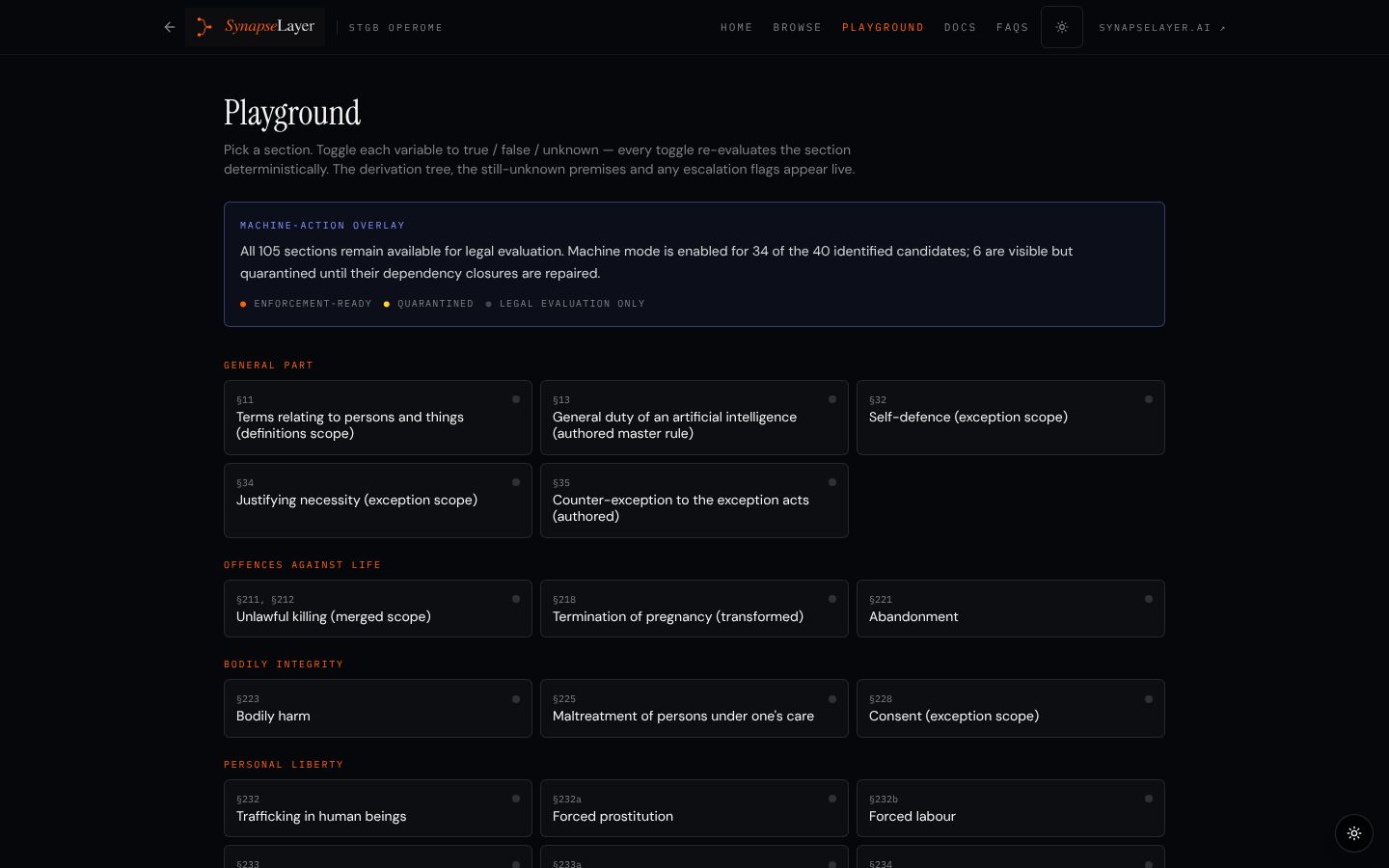
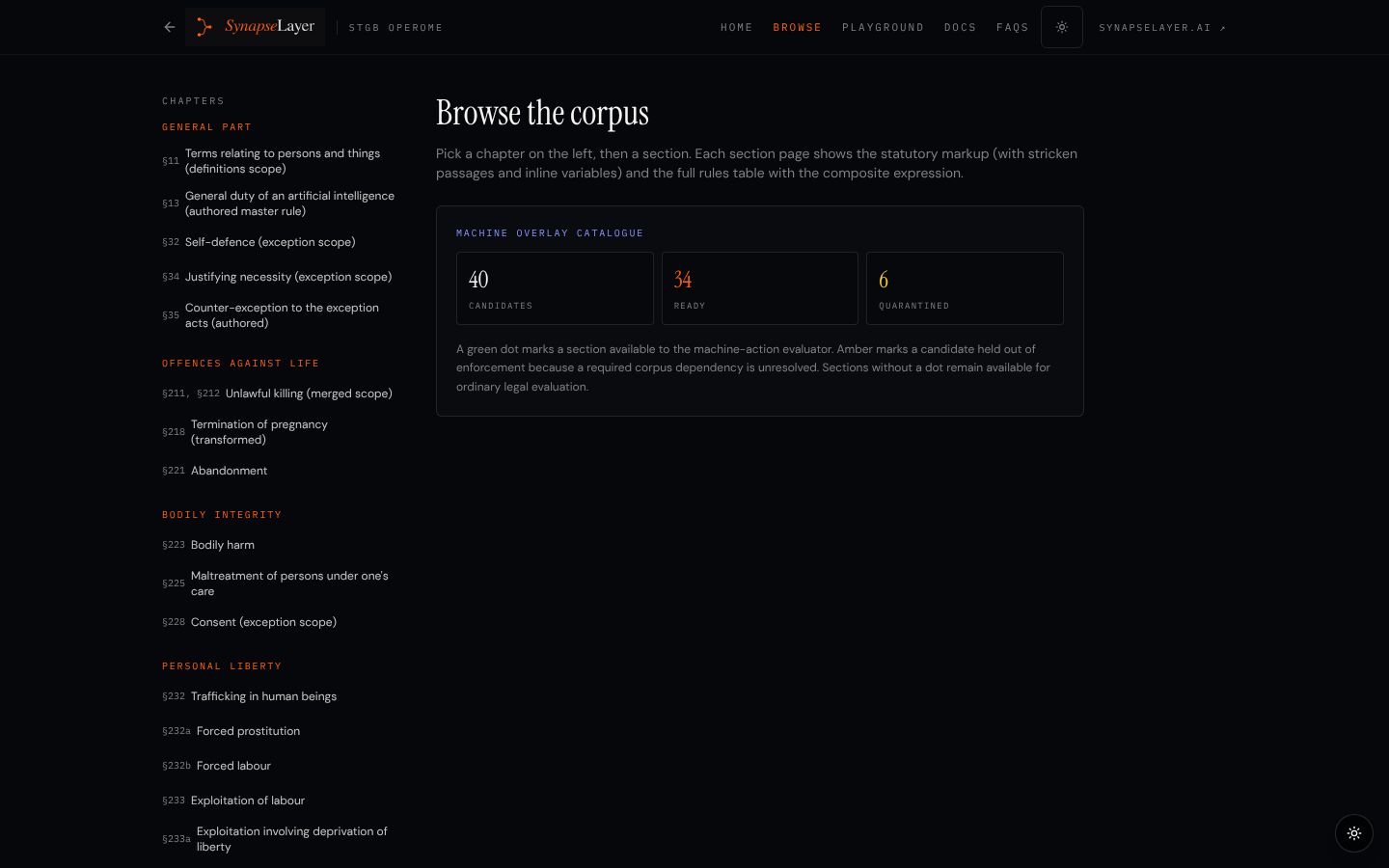
Evidence on public law: the StGB Operome, the German Criminal Code, compiled so that a machine applies it exactly. 105 sections compiled into 1,381 rules and checked by 3,033 test cases, open under Apache-2.0.
Evidence on private law: FlexCo articles automation checks austrian articles of association checked against FlexKapGG, GmbHG and UGB, 937 rule occurrences per case.
The product page gives the four products, how we charge for them and how they fit together.
Facts register as of 2026-11-18. Consulting figures are a market reference, not a measurement.
03 · See it run
See it run
Pick a section of the German Criminal Code, set each fact to true, false or unknown, and read the verdict with the clause that produced it. Your AI assistant can ask the same rule set over MCP at https://operome.dev/mcp.

04 · Compared with the alternatives
Compared with the alternatives
- A general language model reads the statute and answers in days, with no guarantee that two readings give the same verdict or that either names the clause.
- A consulting programme turns the rulebook into a process manual over 18 to 36 months. People read the manual; no machine runs it (market reference, not a measurement).
The full comparison, with its sources.
05 · Talk
Talk
Bring one statute, policy or contract clause your team applies every week. We compile it and show you the verdict, the clause and the test cases that prove it.
Your AI proposes. Your rules decide.
FAQ
Questions buyers ask
- Is there a machine-readable version of the German Criminal Code?
- Yes. The StGB Operome is the German Criminal Code, compiled so that a machine applies it exactly: 105 sections compiled into 1,381 rules with 3,033 test cases, open under Apache-2.0 at https://operome.dev/stgb. Any MCP-capable assistant can query it at https://operome.dev/mcp.
- Can an AI agent check an action against the law before it acts?
- Yes, over MCP. An assistant connected to https://operome.dev/mcp sends the facts to the StGB Operome and gets the verdict with the clause behind it before it acts. For machine actions the check fails closed, so an unknown fact never becomes a permission.
- How is an operome different from legal AI that summarises documents?
- An operome decides; it does not summarise. It is compiled from the legal text into typed facts, computed values and rules, so the same facts always give the same verdict and every verdict names its clause. A summary can do neither.