
Compare
How we compare with the alternatives.
An operome, your rulebook compiled so that a machine executes it exactly, differs from every alternative in one respect: it is compiled from your own documents and it decides the same way every time, with the clause attached. The alternatives model your data, run rules someone typed in, record what happened, move information between systems, or propose an answer with no guarantee. None of them gives you a rule set a machine can run and a person can trace.

The category matrix
| Property | LLM-only agent | Rules engine | Process mining | Operome |
|---|---|---|---|---|
| Rule traceable to its clause | No | Manual mapping | No | Yes |
| Same facts, same answer | No | Yes | Records behaviour, does not decide | Yes |
| Model outside the decision loop | No | Yes | Not applicable | Yes |
| Weeks to a running rulebook | Days, unverified | Months of configuration | Months; it infers a process from traces | Weeks (median from the ledger, to be published) |
| Runs on your premises | Depends on the model | Yes | Usually hosted | Yes |
Each column describes a category, not a company. Named comparisons carry a dated public source per cell, and every cell carries a last-verified date before launch. Facts register as of 2026-11-18.
No Palantir tax.
You pay for two things: compiling your rules and running them.
It works with what you already run. Your systems call the rules over REST, your engineers over the CLI, and any AI assistant that speaks MCP can check an action against them before it acts.
How we charge: a fixed fee for compiling your rules, agreed before work starts, then an annual licence for each rule set in each environment it runs in. No day rates. We quote the fixed scope once we have seen your rulebook.
This describes how SynapseLayer delivers and charges. It states nothing about how any other company delivers or charges.
See the difference live
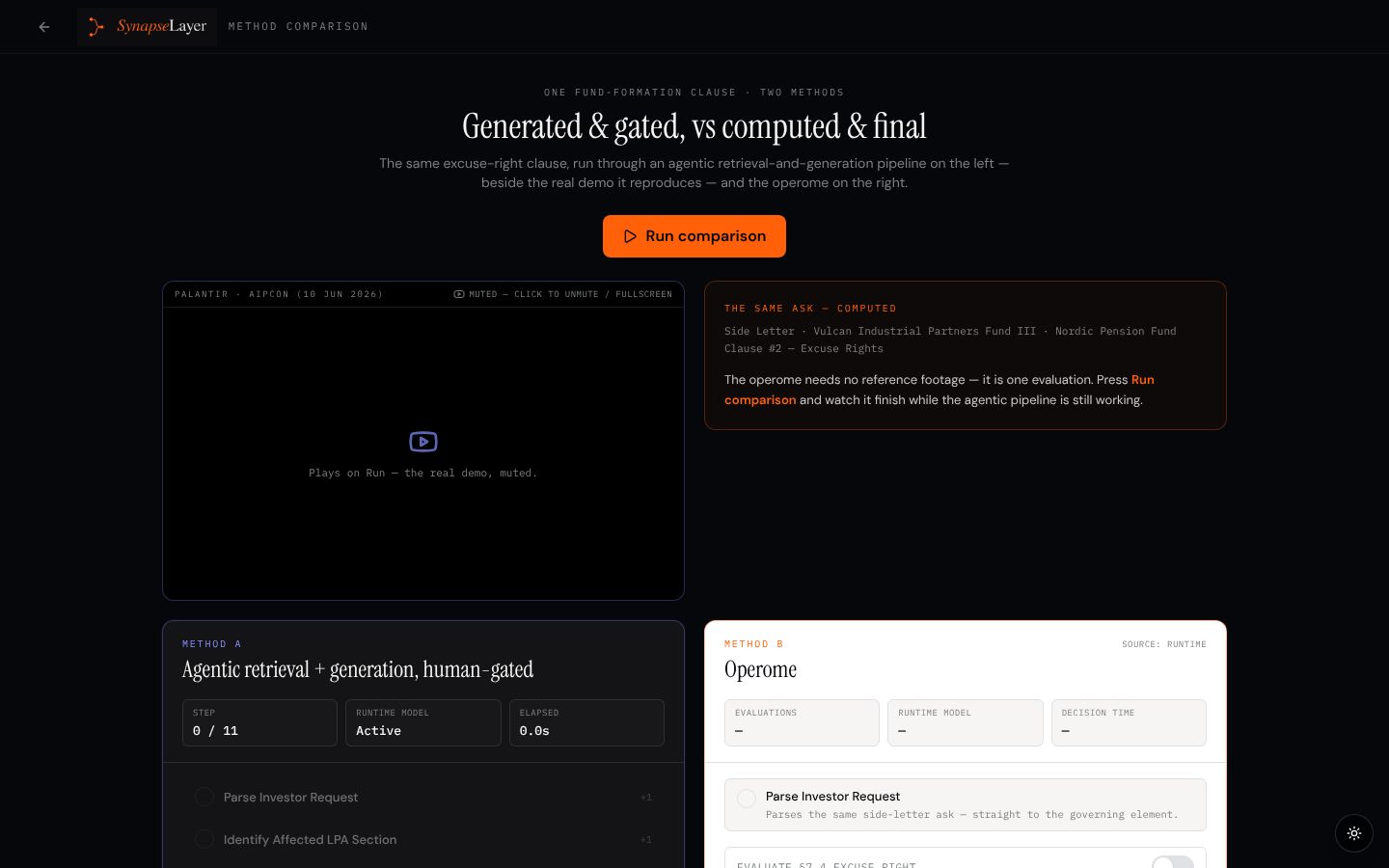
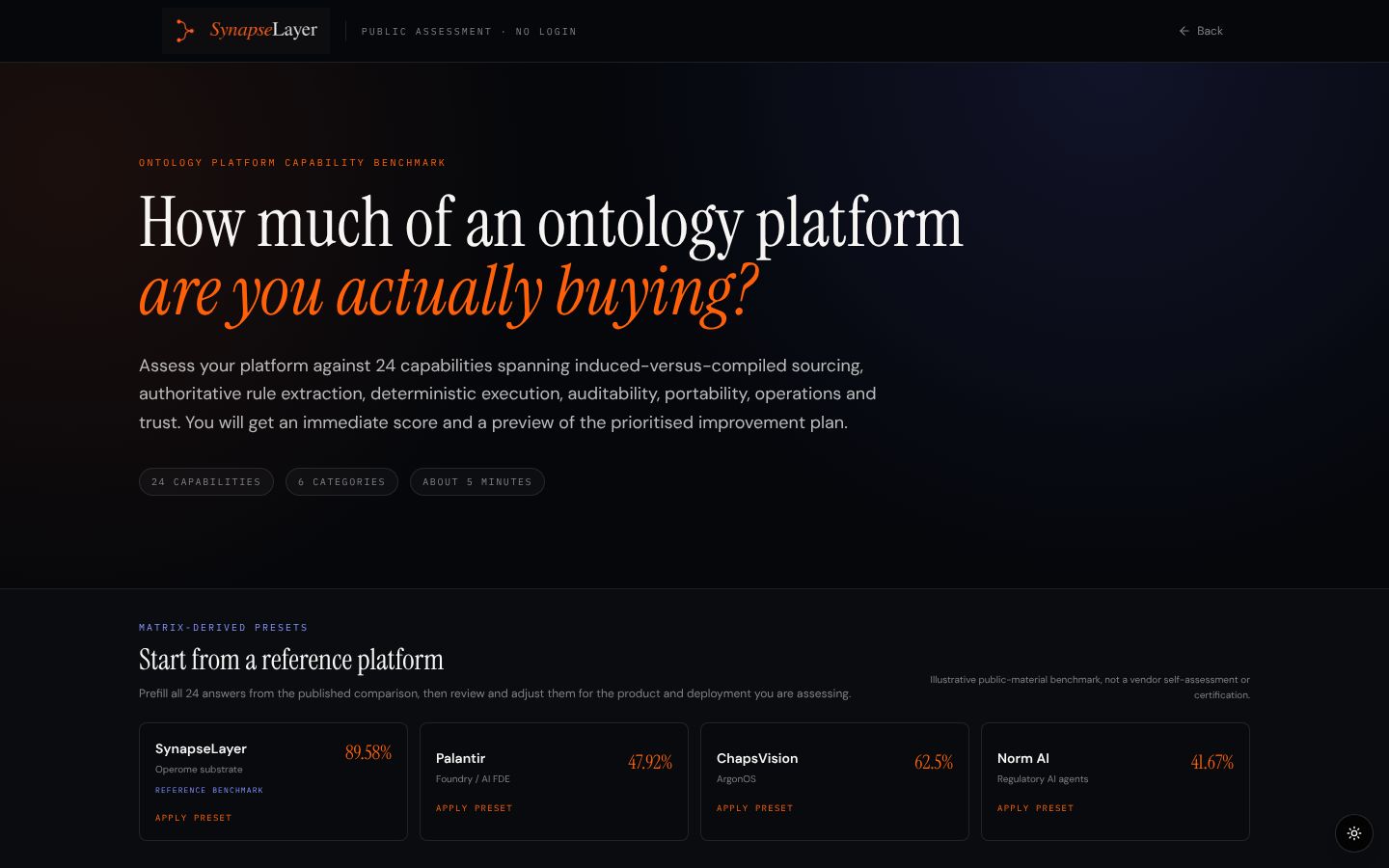
Two tools on operome.dev show the comparison on a real clause and on your own platform. Both are free and need no sign-in.
The category matrix, in words
- Ontology platforms
- They: Model the objects of the enterprise and the data about them. Strong at describing; silent on what may happen next.
- The operome: Compiles the rules rather than the data. The operome decides what may run and names the clause.
- Palantir and the operome, the dated comparison on operome.dev ↗
- Rules engines
- They: Run rules someone configured by hand. No trail back to the source text, and no concept of unknown.
- The operome: Rules are extracted from the governing text with the clause attached, and evaluated with true, false and unknown.
- Process mining
- They: Records what people did and draws the process from the traces. Descriptive, after the fact.
- The operome: Compiled from what the documents say. It stops the breach before it happens.
- RPA and integration
- They: Move information between systems and replay clicks. They carry no judgement on whether the move is allowed.
- The operome: Checks the proposed action against the rules before it runs, over REST, CLI and MCP.
- Language models and agents
- They: Propose fast, in days, with no guarantee that the answer matches the rule.
- The operome: The agent still proposes. The operome decides, with the same output for the same input, every time.
- Consulting
- They: Rewrites the rulebook as process documentation over 18 to 36 months, with variable accuracy (market reference, not a measurement).
- The operome: Operomisation takes weeks and ends with a running operome, a review record and a test run that proves the expected results.
Time and accuracy
| Route | Time to a running rulebook | Accuracy |
|---|---|---|
| Consulting programme | 18 to 36 months | variable |
| General language model | days | no guarantee |
| SynapseLayer operomisation and runtime | weeks | 99.98% |
Consulting row: market reference, not a measurement. SynapseLayer row: accuracy measured in production; see Proof for its source line. How we charge is in words above, under No Palantir tax. Facts register as of 2026-11-18.
Score your platform
Before you compare vendors, score what you have. The Ontology Readiness score at https://operome.dev/ontology-readiness asks how far your platform is from rules a machine can run, and returns the answer with its reasoning.
How we compare
Comparisons on this site name a competitor only with a dated public source per cell. Where no such source exists, the cell describes the category, not the company. Figures labelled a market reference are not measurements.