
Product
What we sell, and how we charge.
SynapseLayer sells four things. We compile your rulebook into an operome, your rulebook compiled so that a machine executes it exactly. The Operome Runtime then checks every action your AI or your staff propose before it runs. Operome Apps are the working screens built from those rules. The free public operomes let you test the method on public law first. The first step takes weeks, at a fixed scope and fee agreed before work starts.
The four products
| Step | Name | What you get | How you buy it |
|---|---|---|---|
| 1 | Operomisation | We compile your rulebook into an operome. Every rule names its source clause, a reviewer signs it off, and a test run proves it gives the expected answers. | Fixed scope and fee, agreed before work starts. Delivered in weeks. |
| 2 | Operome Runtime | Checks every action your AI or your staff propose before it runs. The answer is permitted, required, blocked, routed or escalated, with the clause. Reached over REST, CLI and MCP, on your servers or EU-hosted. | Annual licence per operome, per environment. |
| 3 | Operome Apps | Working screens built from the operome. Input forms, a rule board, test scenarios and a receipt for every decision. | Included with the runtime. |
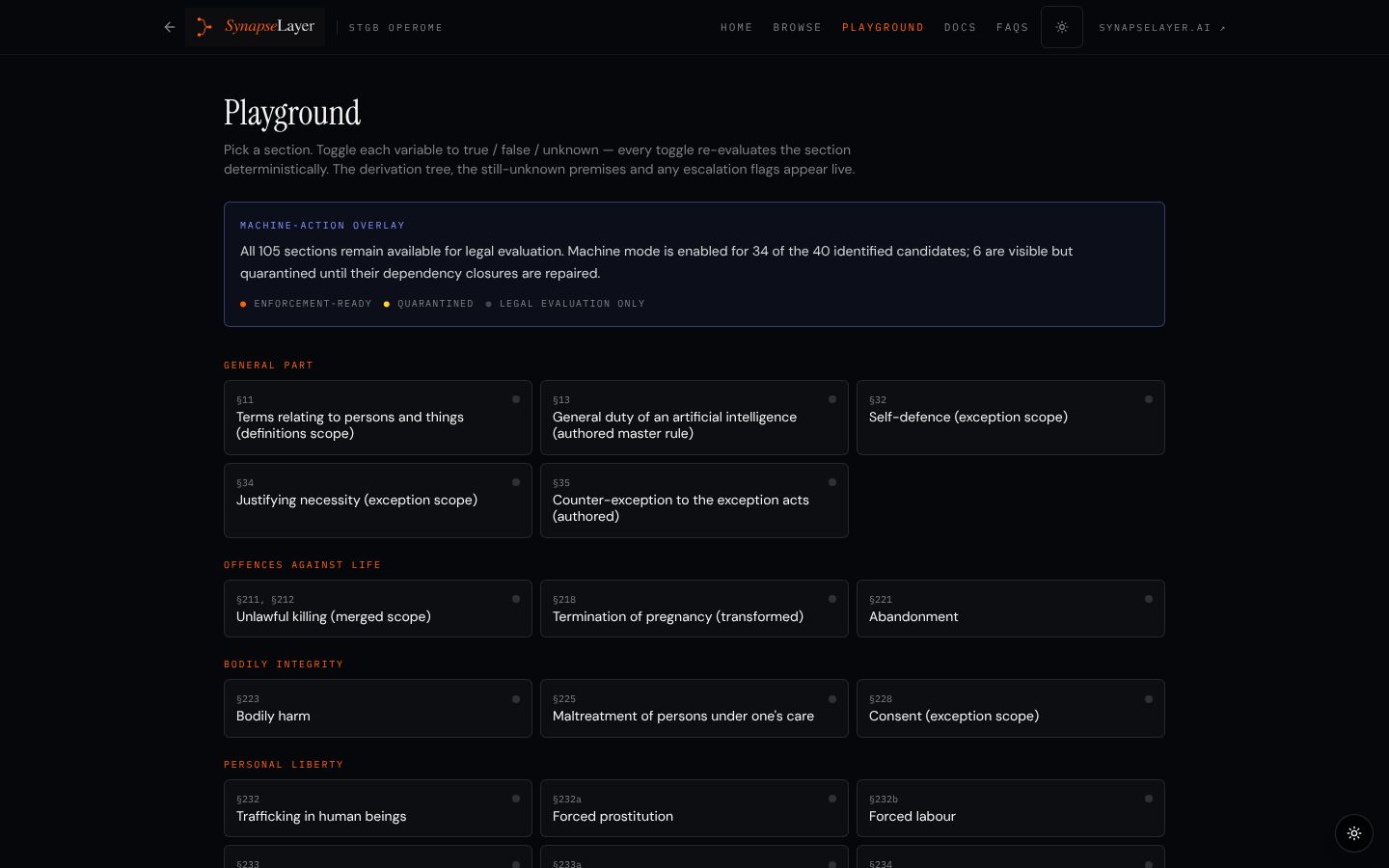
| 4 | Open and sector operomes | Free tools that show the method on public law. The StGB Operome, the EU AI Act classifier and the Ontology Readiness score. | Free. |
Facts register as of 2026-11-18. Every figure on this site comes from it.
The product, live
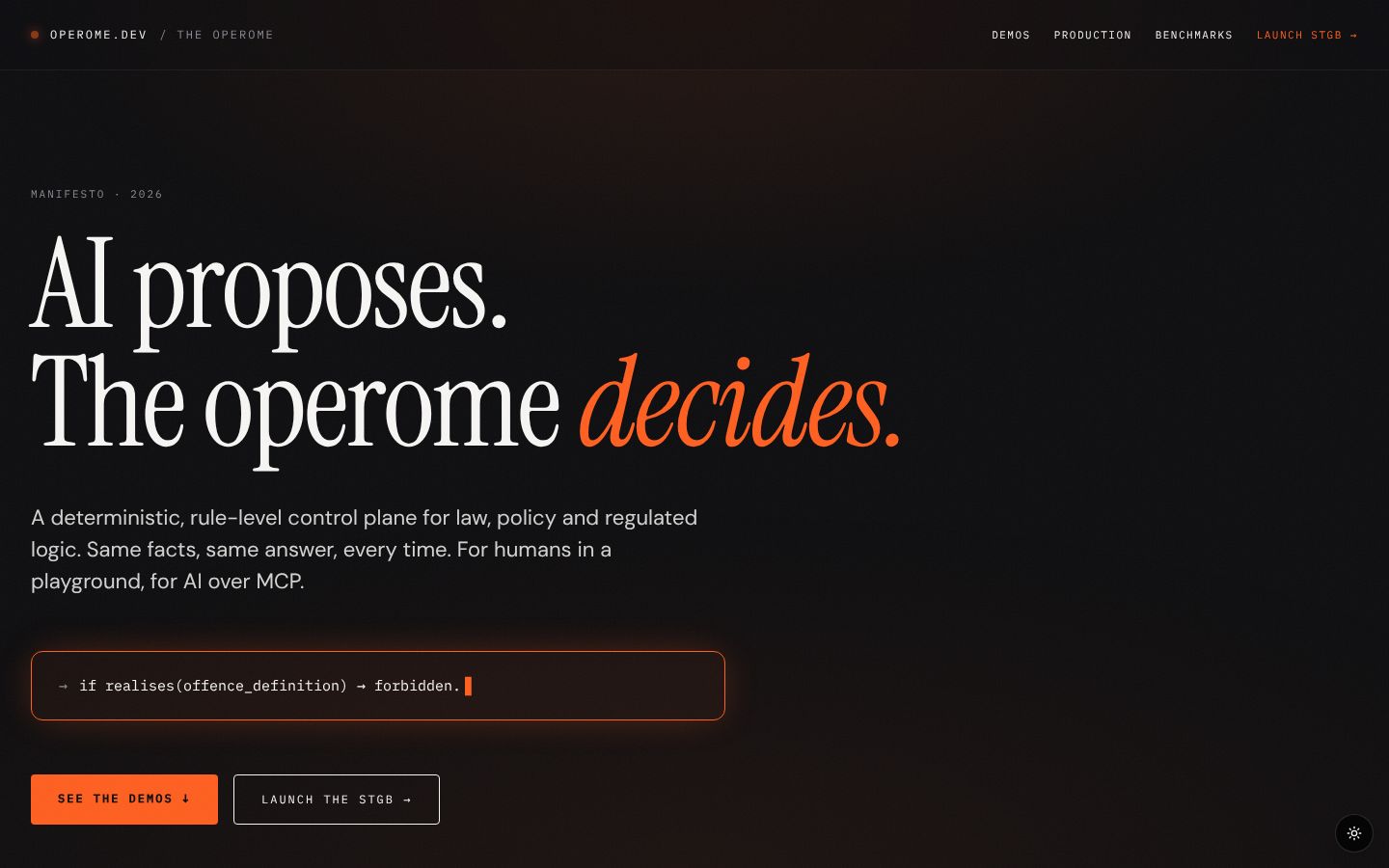
Both tools below run in public at operome.dev. Open either one and use it; no sign-in is needed.
How the four fit together
Start with operomisation. We read the documents that govern you and compile them into an operome. Every rule names its clause, a reviewer signs it off and a test run proves it gives the expected answers. Without this step there is nothing to run.

Run it on the Operome Runtime. It holds the compiled operome and checks every proposed action before it runs: permitted, required, blocked, routed or escalated, each with the clause that decided. It answers over REST, CLI and MCP, on your servers or EU-hosted.

See it in Operome Apps. The screens are built from the operome itself: input forms, a rule board, test scenarios and a receipt for every decision. They come with the runtime.

Try it first on the open operomes. They are free and run on public law, so you can test the method before you hand over a rulebook of your own.

Compared with the alternatives
A consulting programme rewrites your rules on paper. It takes 18 to 36 months, with variable accuracy and nothing a machine can run at the end. A general language model answers in days with no guarantee. Operomisation takes weeks, and the runtime has recorded 99.98% accuracy in production. The comparison, with sources.
Consulting figures are a market reference, not a measurement. Figures from fDesk's production system, November 2026.
No Palantir tax.
You pay for two things: compiling your rules and running them.
It works with what you already run. Your systems call the rules over REST, your engineers over the CLI, and any AI assistant that speaks MCP can check an action against them before it acts.
How we charge: a fixed fee for compiling your rules, agreed before work starts, then an annual licence for each rule set in each environment it runs in. No day rates. We quote the fixed scope once we have seen your rulebook.
This describes how SynapseLayer delivers and charges. It states nothing about how any other company delivers or charges.