Product · Step 2
Every action checked before it runs.
The Operome Runtime checks every action your AI or your staff propose before it runs, against your operome, your rulebook compiled so that a machine executes it exactly. The answer is permitted, required, blocked, routed or escalated, with the clause that decided. It runs on your servers or EU-hosted and answers over REST, CLI and MCP. Annual licence per operome, per environment.
Five answers
An agent, a screen or a person proposes an action with its facts. The runtime checks it against the operome and returns one of five answers, each with the clause that produced it.
- PermittedThe action may go ahead. The clause that permits it is attached.
- RequiredThe rules oblige the action. Leaving it out would be the breach.
- BlockedThe action does not run. The clause that blocks it is the receipt.
- RoutedThe action goes to the role the rules name for it.
- EscalatedA person decides, because the rules say so or because a fact is unknown.



See it live
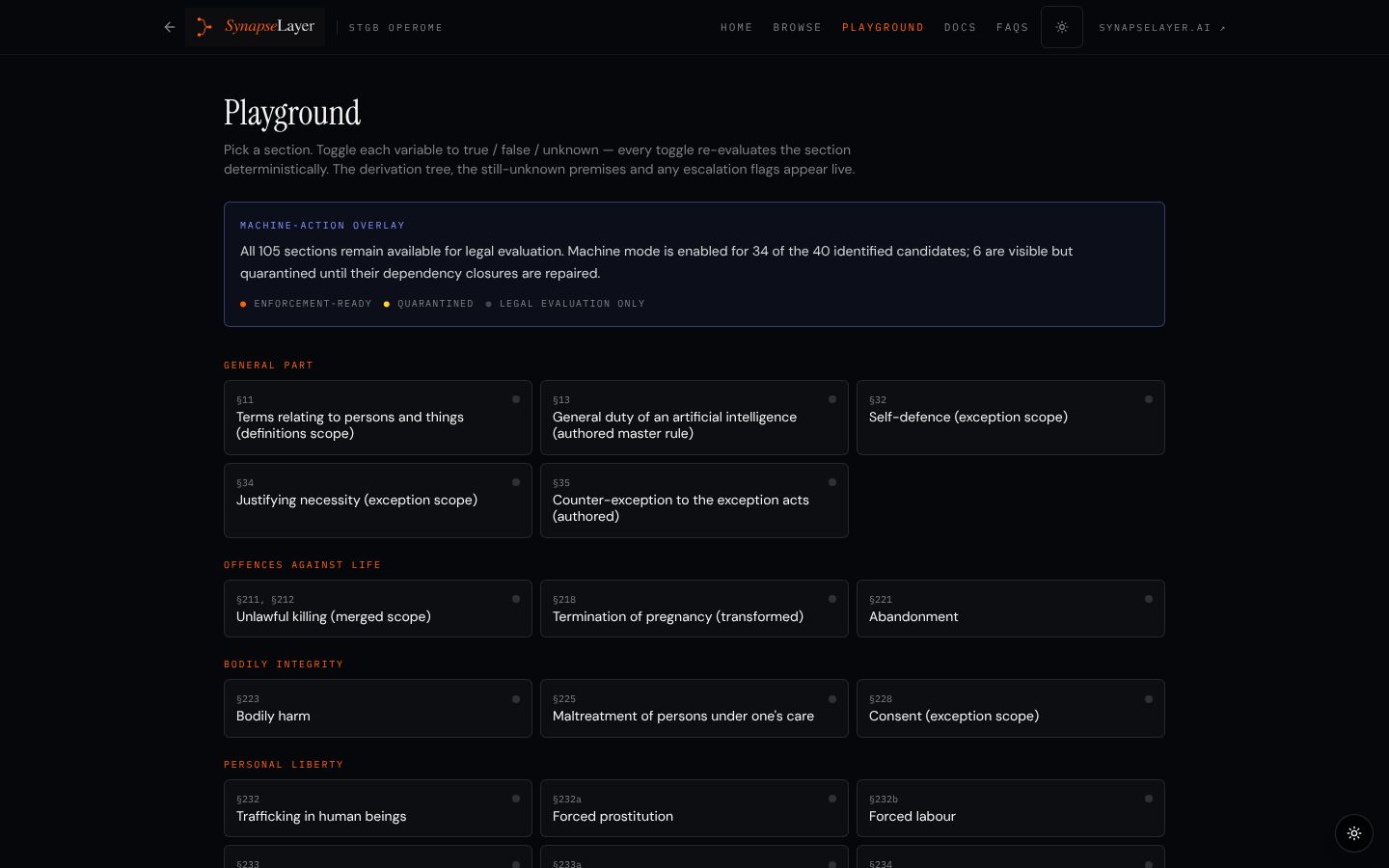
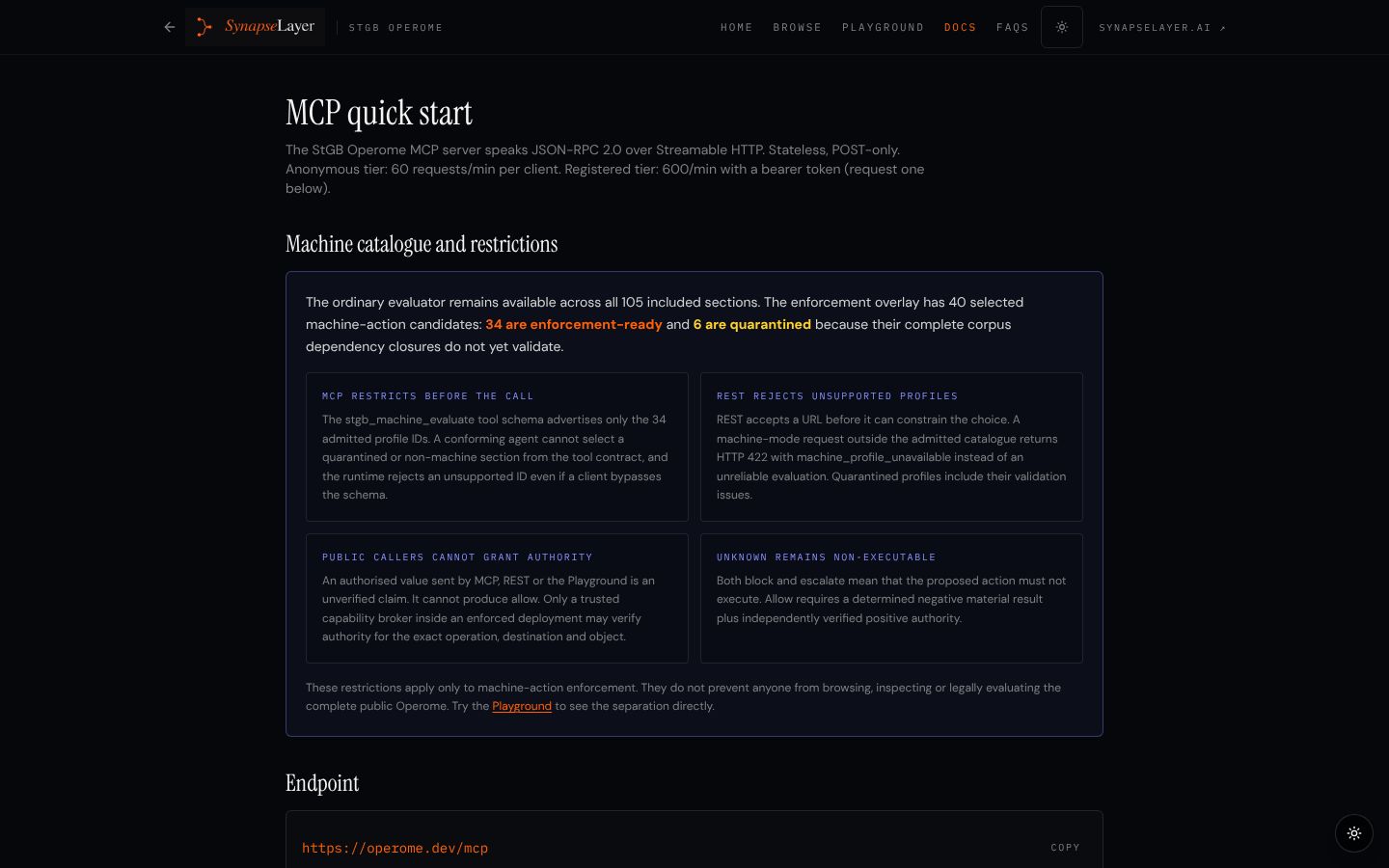
The StGB Operome runs on this runtime in public. Use it in the browser, or read how an assistant connects to it.
Three ways to connect
- REST for your systems: send the facts of a proposed action, get the verdict and the trace.
- CLI for your engineers and your pipelines: the same check from a terminal or a CI job.
- MCP for your AI assistants: the operome appears as tools the assistant calls before it acts. The StGB Operome already answers this way at https://operome.dev/mcp. Add it to your assistant.
The same facts, the same answer
The same input always gives the same output. Facts are true, false or unknown. An unknown stays unknown and never turns into a permission by default. No model sits in the decision path, so the runtime answers the same on the day of the audit as on the day of the decision.
In production the technology has recorded 100,068 validations at 99.98% accuracy with 0 compliance violations. The proof page.
Figures from fDesk's production system, November 2026.
Where it runs
On your servers or EU-hosted, licensed per operome and per environment. The operome is a file that travels with your deployment. The runtime needs nothing from us at decision time. Security and deployment.
Who sees your data. The runtime needs nothing from us at decision time and sends nothing out. For client support we need to be able to access your data, so that possibility exists; our standard setup does not use it, and only a very limited number of our team members have access. If you use our deterministic rule sets with AI, the AI model of your choice reads your data too.