
Sectors · Government
Public rules, applied the same way every time.
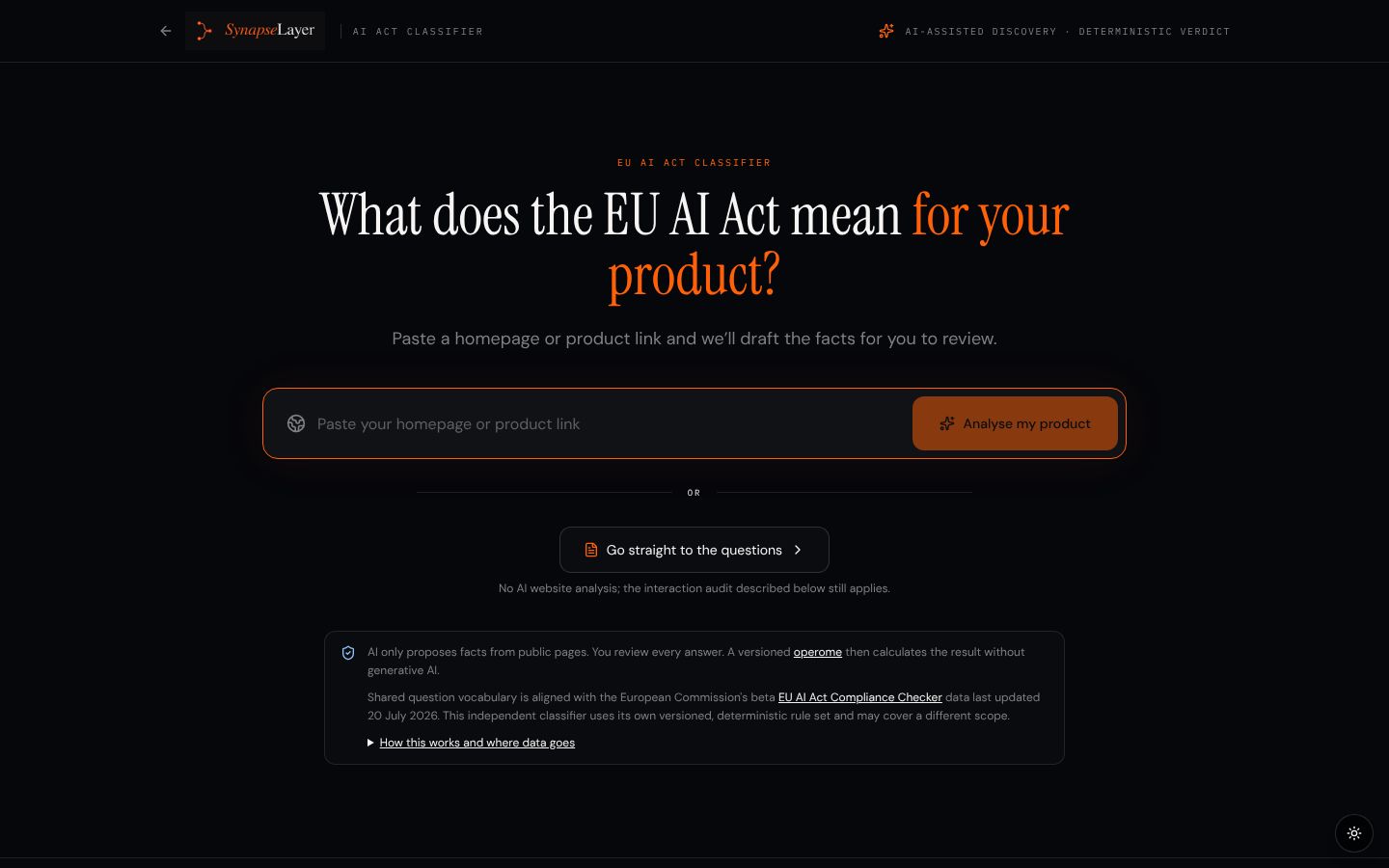
SynapseLayer compiles the statutes, ordinances, procurement rules, benefit rules, permit conditions and procedures your office applies into an operome, your rulebook compiled so that a machine executes it exactly. A case goes in, and the decision comes out with the provision behind it, the same way in every office. Public law already runs this way in the EU AI Act classifier, free, at operome.dev/eu.
01 · Your rules today
Your rules today
Your rules are public and binding: statutes, ordinances, procurement rules, benefit rules, permit conditions, administrative procedures. Case officers read them, apply them to a file and write a decision. The reading is expert, the application is manual, and the trail from fact to decision lives in a case note. Two offices can reach two answers on the same file.
Digital government so far has put the form online, and the rule has stayed with the person. The portal collects the facts; an officer still decides, or a custom system encodes one reading of the rule and falls behind the moment the law is amended. A language model cannot replace either: it cannot promise the same decision twice, and it cannot name the provision that decided.
02 · What you get
What you get
Operomisation: we compile the statute, ordinance or benefit rule into an operome. Every rule names its provision, a reviewer signs it off, and a test run proves the expected decisions. A fixed scope and fee agreed before work starts, delivered in weeks.
Operome Runtime: every decision checked against the compiled statute before it is issued, on your own servers or EU-hosted, over REST, CLI and MCP.
Operome Apps: screens for the case officer and for the applicant, built from the same compiled rules: the facts, the rules as they settle, the decision with its provision.
Evidence on public law: the EU AI Act classifier takes the facts of an AI system and returns its risk class with the article behind it. Evidence on company law: FlexCo articles automation checks austrian articles of association checked against FlexKapGG, GmbHG and UGB, 937 rule occurrences per case, and a Gibraltar company-formation operome exists as a private review build.
What it is worth: The Operome Dividend estimates the effect of compiling public administration alongside companies, through two channels a ministry knows from its own case load: verification cost and hours redeployed. The figures are in the essay.
The product page gives the four products, how we charge for them and how they fit together.
Facts register as of 2026-11-18. Consulting figures are a market reference, not a measurement. The Gibraltar company-formation operome is a private review build, not a public link.
03 · See it run
See it run
The EU AI Act classifier at operome.dev/eu takes the facts of an AI system and returns its risk class under the Regulation, with the article that decides it: the same facts, the same class, every time. Company formation runs the same way. FlexCo articles automation checks Austrian articles of association against FlexKapGG, GmbHG and UGB, and the Gibraltar company-formation operome, a private review build, is shown to public-sector buyers on request.
FlexCo articles automation
sign in on operome.dev

04 · Compared with the alternatives
Compared with the alternatives
- A consulting programme turns the rulebook into a process manual over 18 to 36 months. People read the manual; no machine runs it (market reference, not a measurement).
- Custom e-government software encodes one reading of the rule in code that only its developers can change. When the statute is amended the system lags the law, and no screen shows which provision produced a decision. An operome is recompiled from the amended text, and every decision names its provision.
The full comparison, with its sources.
05 · Talk
Talk
Bring one statute, benefit rule or permit condition your office applies every week. We compile it and show you the decision, the provision and the test cases that prove it, on your own cases.
Your AI proposes. Your rules decide.
FAQ
Questions buyers ask
- Can a public authority use AI to decide cases under a statute?
- Yes, once the statute is compiled into an operome. The AI collects the facts and proposes; the operome decides and names the provision, so the same facts give the same decision and every decision can be reviewed against the law. The EU AI Act classifier at operome.dev/eu shows this on public law.
- How do we check an AI system against the EU AI Act?
- Open the EU AI Act classifier at https://operome.dev/eu, enter the facts of the system and read its risk class with the article behind it. The classifier is a free open operome from SynapseLayer. The same method compiles your own statutes, procedures and permit conditions.
- What happens to a compiled rule set when the law is amended?
- We recompile the amended text. The changed provisions become changed rules, each traced to its clause; a reviewer signs them off, and a test run proves the rest of the operome is unchanged. The system follows the law instead of lagging behind it.