
Sectors · Defence
Rules of engagement a machine cannot bend.
SynapseLayer compiles rules of engagement, standing orders, caveats and doctrine into an operome, your rulebook compiled so that a machine executes it exactly. An action proposed by an agent or a staff officer is permitted, blocked or escalated by the rule itself, with the clause attached, before it runs. La Base Adelantada, a forward-base rules-of-engagement demonstrator, runs 153 scenario vectors across 25 children on this method.
01 · Your rules today
Your rules today
Your rules already exist and already bind: ROE cards, standing orders, national caveats, STANAGs, doctrine. People who know them apply them under time pressure. They are audited after the event, from logs and memory.
A generative assistant in that loop proposes with confidence and cannot show the authority behind its proposal. In defence the refusal must be as traceable as the permission.
02 · What you get
What you get
Operomisation: we compile the rules of engagement, standing orders and caveats into an operome. Every rule names its clause, a reviewer signs it off, and a test run proves the expected results. A fixed scope and fee agreed before work starts, delivered in weeks.
Operome Runtime: every proposed action checked before it runs, on your own network with no model in the decision path, over REST, CLI and MCP.
Operome Apps: the mission console your staff see, built from the same rules: the facts, the rules as they settle, the paper with its authority and its trace.
The demonstrator: La Base Adelantada, rules of engagement for a forward base, checked before each order runs, with 153 delivered scenario vectors across 25 children. Every verdict names the clause that produced it.
The product page gives the four products, how we charge for them and how they fit together.
Facts register as of 2026-11-18. Every figure on this site comes from it.
03 · See it run
See it run
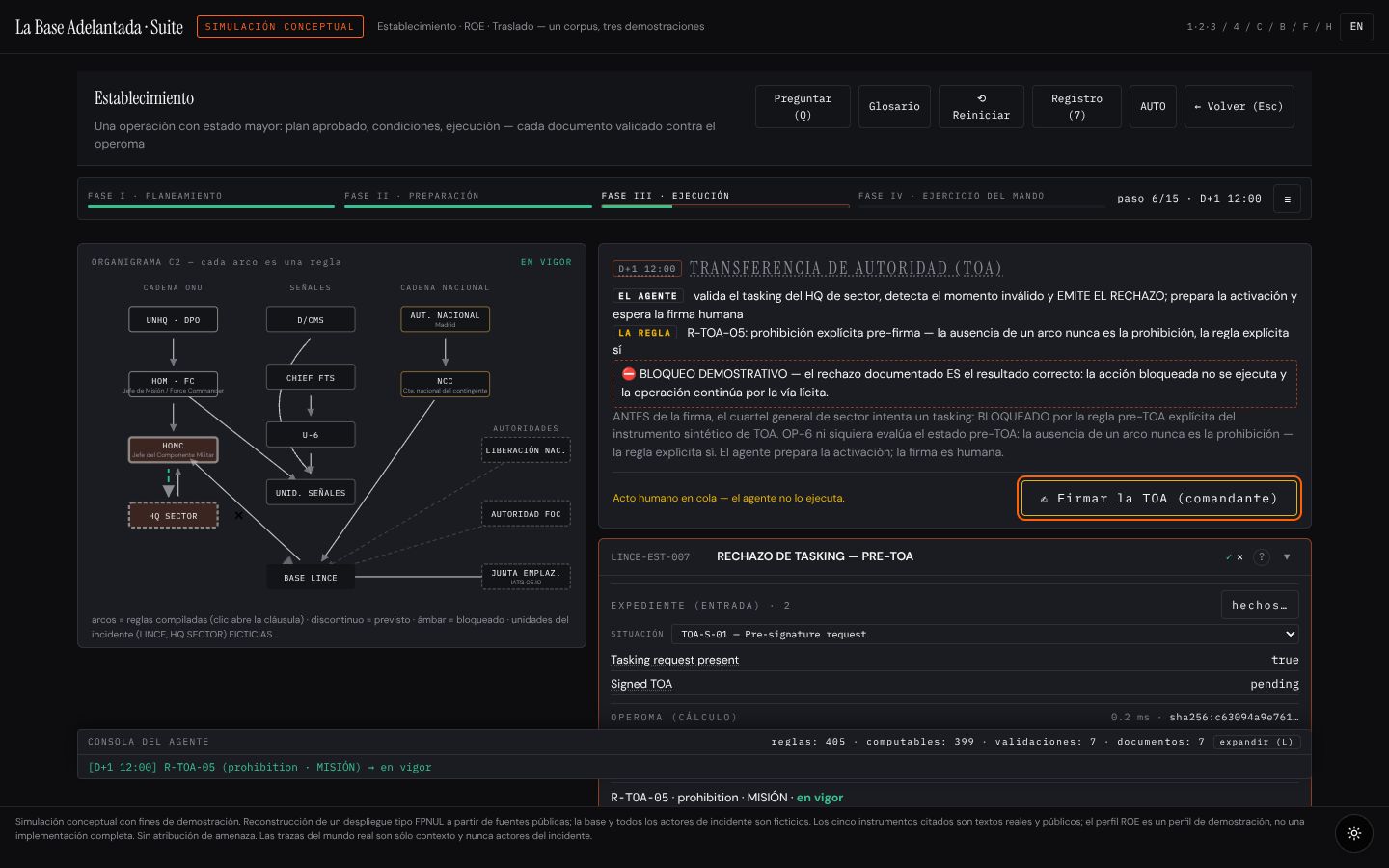
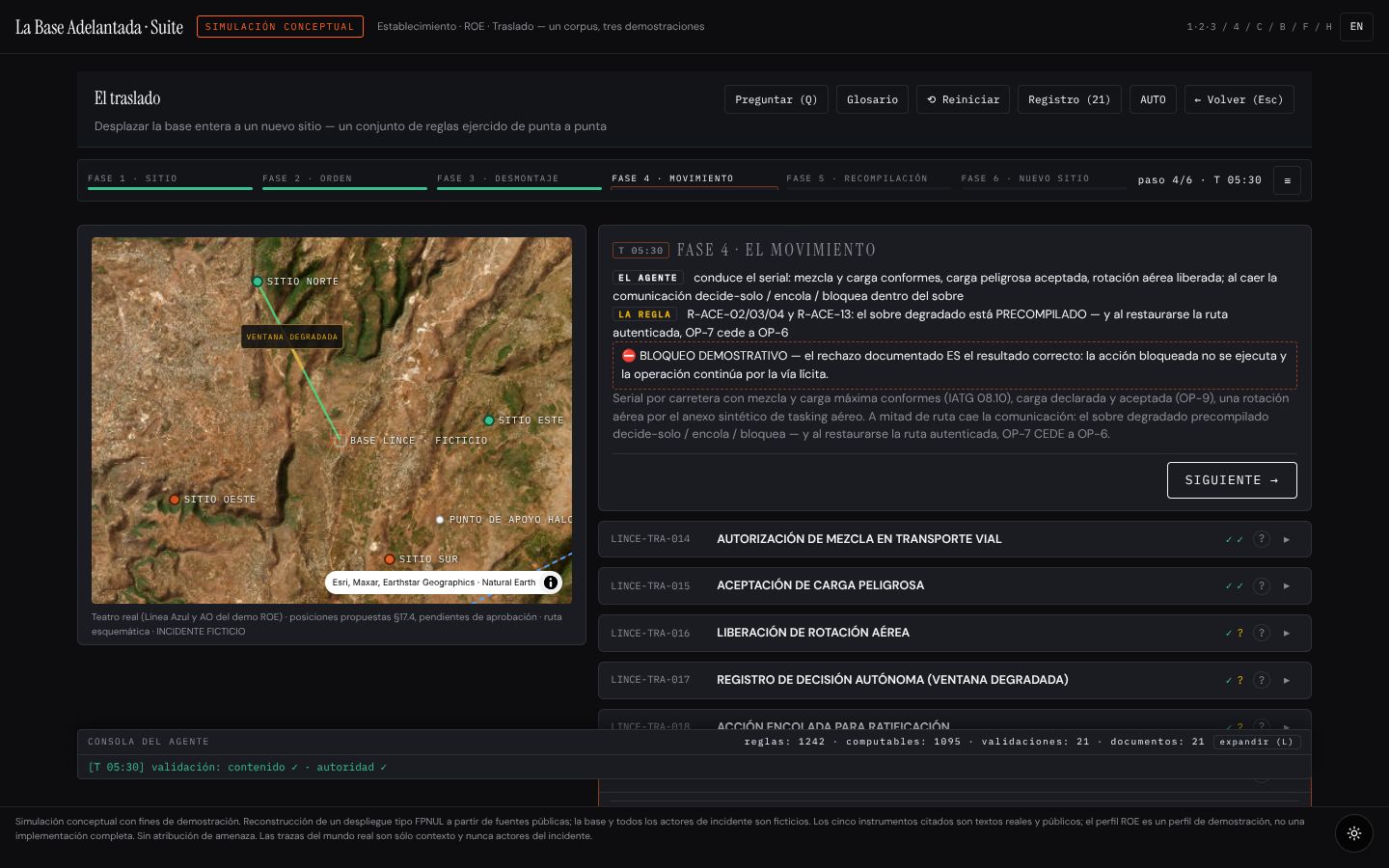
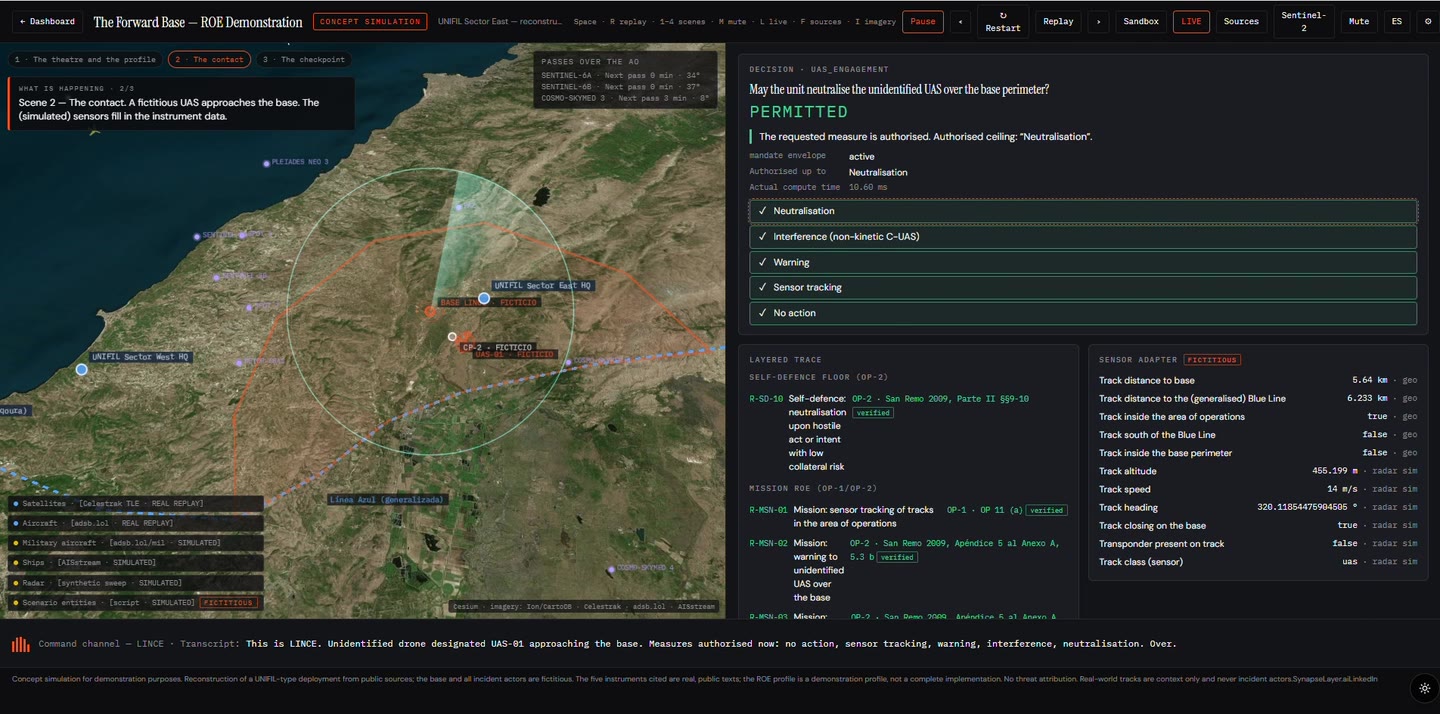
Rules of engagement for a forward base, checked before each order runs: a forward base is set up, command is exercised and the base moves. Each proposed action is checked against the compiled rules of engagement and each refusal names its clause. Sign in on operome.dev to run it.

04 · Compared with the alternatives
Compared with the alternatives
- A rules engine runs rules someone typed into it. It carries no trail back to the order or the caveat, and it cannot say "unknown" when a fact is missing.
- A generative assistant answers in days with no guarantee that the answer respects the rules of engagement, and it cannot be bound to refuse.
The full comparison, with its sources.
05 · Talk
Talk
Bring one rule of engagement and one scenario that must end in a refusal. We compile the rule, run the scenario and show you the refusal with its clause. Deployment is on your own network.
Your AI proposes. Your rules decide.
FAQ
Questions buyers ask
- Can an AI agent be bound by rules of engagement?
- Yes, once the rules of engagement are compiled into an operome. The agent proposes an action, the Operome Runtime checks it against the compiled rules and returns permitted, required, blocked, routed or escalated with the clause attached. A blocked action does not run. The agent proposes; the operome decides.
- Does a deterministic rule set still work when the facts are unknown?
- Yes. The evaluator works with true, false and unknown. The evaluator never guesses a missing fact: it stays unknown. A machine action needs positive authorisation before it is allowed, so an unknown cannot turn into a permission.
- Can the Operome Runtime run disconnected, on-premise, in a classified environment?
- Yes. The Operome Runtime runs on your own servers or EU-hosted, licensed per operome and per environment. No model sits in the decision path, so it runs where your network runs and the same input always gives the same output.