SAP Is Fighting for Survival
March 6, 2026
The SaaS-pocalypse validates the case for deterministic AI infrastructure.
The SaaS-pocalypse validates the case for deterministic AI infrastructure.
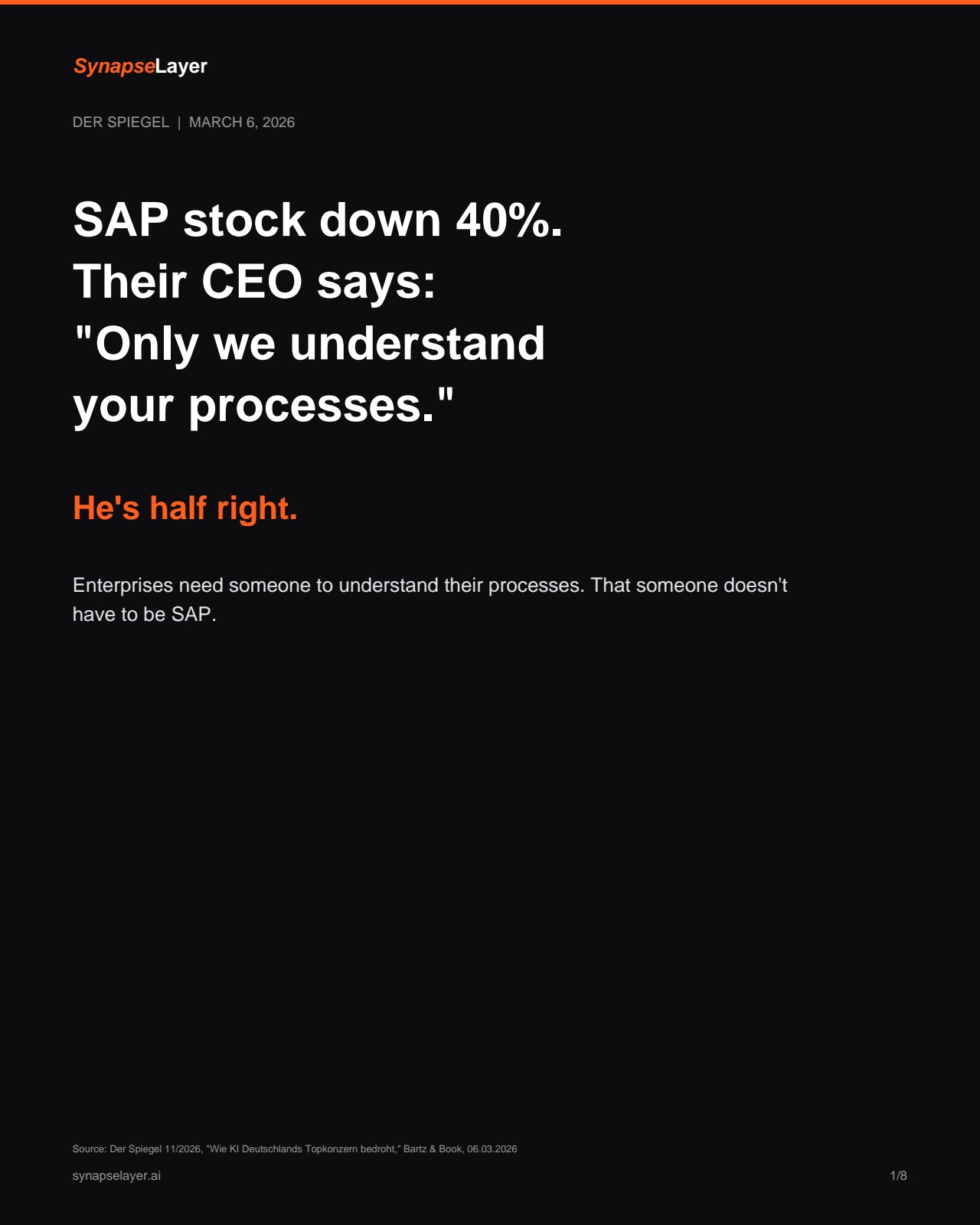
Today, Der Spiegel published a cover story on SAP. The headline: "How AI Threatens Germany's Top Corporation." SAP stock is down 40% from its all-time high. CEO Christian Klein is making AI his personal priority. The investment bank Jefferies has coined a term for what is happening across the software industry: the "SaaS-pocalypse."¹
The article is worth reading in full, but two quotes from SAP leadership stand out.
SAP CEO Christian Klein told Der Spiegel that enterprise customers keep coming back because, in his words, "we need you to understand our processes, because only SAP can prepare all the data." SAP COO Sebastian Steinhaeuser added that while anyone can now code software with AI, extracting the right conclusions for business processes while complying with all regulations requires decades of experience and access to data from over 30,000 enterprise customers.¹
They are describing what we built. Almost word for word.
The Problem SAP Is Defending Against
The Spiegel article lays out the threat clearly. GPT-5.3 Codex and Claude Opus 4.6 now write code better than most human programmers. Enterprises are realizing they can build their own software rather than paying SAP subscription fees. German AI entrepreneur Jan Philipp Harries told Der Spiegel that he considers three quarters of the SaaS business model to be at risk in the long run.¹
The consequences are already visible. Salesforce customers avoided the company's AI tools for months. ServiceNow is under the same pressure. Blue Owl Capital, which manages over $300 billion and is heavily invested in software companies through private credit, had to freeze redemptions on one of its funds and force-sell assets. Nassim Taleb, who warned about the banking sector before the 2008 crisis, now says there will "definitely" be software company bankruptcies. Jamie Dimon, CEO of JPMorgan Chase, draws direct parallels to the pre-2008 period.²
SAP's Defense Is the Right Argument in the Wrong Package
SAP's leadership is making the correct observation. They are saying that understanding business processes and enforcing compliance rules is harder than writing code. That the real value is in the logic layer, not the application layer. That enterprises need infrastructure that comprehends their processes before AI agents can operate safely.
All of that is true. Where SAP's argument breaks down is the conclusion: that only SAP can provide this because they have the data.
SAP's AI solution, Joule, is a layer bolted onto existing SAP software. It summarizes, analyzes, and recommends. It operates within the SAP ecosystem and requires customers to remain SAP customers. That is a data moat defense, not an infrastructure solution.
The alternative: automated extraction of deterministic business rules from any documented process, for any enterprise, on any platform. No vendor lock-in required.
What the SaaS-pocalypse Actually Threatens
The narrative lumps all software companies together, but the threat is not uniform. Application-layer SaaS companies whose features can be replicated by AI code generation are genuinely at risk. If an AI agent can write the same procurement workflow or HR management tool that an enterprise currently rents from a SaaS vendor, the subscription model collapses.
Infrastructure companies occupy a different position entirely. As AI agents proliferate and enterprises build more of their own software, the need for deterministic rule enforcement increases, not decreases. Every custom-built tool, every AI-generated workflow, every autonomous agent still needs to comply with business rules, regulatory requirements, and operational constraints. Those rules live in documents: policy manuals, contracts, regulatory filings, operating procedures. Someone needs to extract them, formalize them, and enforce them.
That extraction is the bottleneck. Consulting teams take 18 to 36 months and charge millions to manually map business rules into executable logic. Automated ontology extraction compresses that to weeks.
Everyone Agrees on the Problem
The striking pattern is not that SAP sees this. It is that every major technology company has arrived at the same conclusion from a different direction.
SAP CEO Christian Klein says enterprises need someone to understand their processes and handle their data correctly. SAP COO Sebastian Steinhaeuser says the hard part is extracting the right business logic while complying with all regulations.¹
Palantir CEO Alex Karp told Larry Fink at the World Economic Forum in Davos in January 2025 that you cannot do underwriting with just an LLM, that you need an ontology layer that translates enterprise logic into something AI can operate within.³
OpenAI launched Frontier in February 2026 and described it as "a semantic layer for the enterprise" that connects AI agents to business context.⁴
Salesforce CEO Marc Benioff is considering renaming his entire company "Agentforce" to signal the shift toward AI agents embedded in enterprise workflows.
They all agree that AI agents need to understand business processes and follow rules. None of them have automated the extraction of those rules from documentation.
The Logic Layer, Not the Data Layer
SAP defends a data moat. Their argument is that 30,000+ enterprise customers and decades of accumulated process data make them irreplaceable. That may be true for customers already embedded in the SAP ecosystem.
But the moat that matters across all enterprises, regardless of which software they use, is the logic layer. The formalized, deterministic business rules extracted from documented processes that constrain how any AI agent, any custom tool, any automated workflow is allowed to operate.
That layer is platform-agnostic. It does not require you to be an SAP customer, a Salesforce customer, or a Palantir customer. It works on any documented process. It turns unstructured documentation into deterministic infrastructure.
SAP sees the problem. They are defending it with vendor lock-in. The market needs it solved with open infrastructure.
What This Means Going Forward
The SaaS-pocalypse is real, but it is more nuanced than the headline suggests. Application companies whose value proposition can be replicated by AI code generation will face sustained pressure. The private credit market's exposure to these companies, which JPMorgan's Dimon and others have flagged, is a genuine systemic risk.
Infrastructure companies that provide the deterministic constraint layer sit on the opposite side of that trade. Every new AI agent, every piece of custom enterprise software, every autonomous workflow increases the demand for rule extraction and enforcement. The more capable AI becomes at building applications, the more critical the logic layer underneath those applications becomes.
SAP is fighting for survival by defending its data moat. The survival of enterprise AI reliability depends on something different: automated extraction of the rules that make AI trustworthy.
Footnotes
- Der Spiegel 11/2026, "Wie KI Deutschlands Topkonzern bedroht," Tim Bartz & Simon Book, March 6, 2026 [source]
- Jefferies, "SaaS-pocalypse" industry research, 2026; Citrini Research, "The 2028 Global Intelligence Crisis," February 2026 [source]
- Palantir CEO Alex Karp, interview with Larry Fink (BlackRock CEO), World Economic Forum Davos, January 2025 [source]
- OpenAI, "Introducing OpenAI Frontier," February 2026 [source]
- MIT NANDA, "The GenAI Divide: State of AI in Business 2025," July 2025 [source]
- McKinsey, "The State of AI in 2025: Agents, Innovation, and Transformation," November 2025 [source]