Unlocking the $100 Trillion Handshake
April 28, 2026
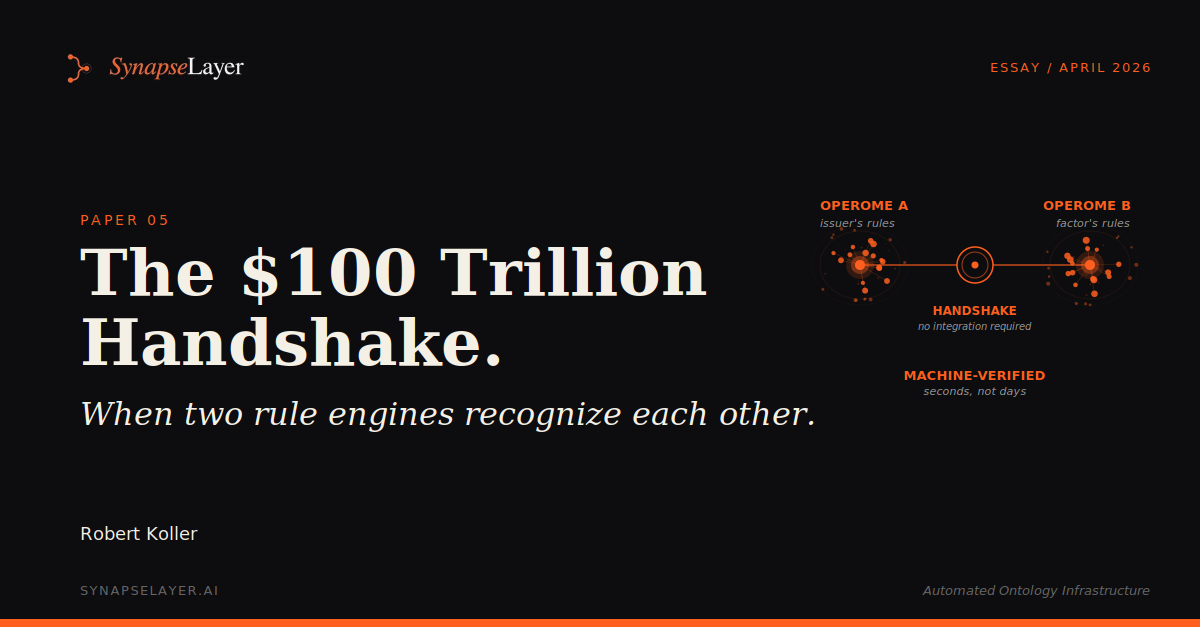
When two rule engines recognize each other
Elon Musk announced Macrohard on March 11.1 Grok as navigator, Tesla-built agents executing, the whole system supposedly capable of emulating the function of entire companies. Six weeks later, the cofounder Toby Pohlen had resigned after sixteen days, two earlier project leaders had quit, and most of the engineering team had moved on or out.2 Macrohard has not yet demonstrated one autonomous company operating internally. The problem it has not touched is the harder one: transacting with another autonomous company.
That problem is not whether Grok can write code. It is what happens when Macrohard’s agents need to pay a supplier whose own agents are running a different rule set, in a different jurisdiction, under different regulatory obligations. One autonomous company is a novelty. The economy that contains thousands of them requires something that does not yet exist: a shared grammar for machines to agree on what rules apply when they do business with each other.
The conversation about autonomous companies has fixated on the single-company question. Can one AI run one business. But businesses do not operate in isolation. They transact, contract, interpret each other’s policies, reconcile each other’s terms, enforce each other’s obligations. Every one of those activities is a rule-based handshake between two organizations. When both sides are human, the handshake takes days and generates a paper trail. When both sides are machines, the handshake either happens in milliseconds with deterministic rules on both ends, or it does not happen at all.
This paper is about that handshake. And about why the first companies ready for it will capture economic advantage that compounds for decades.
What the last attempt got right
The last people who bet seriously on executable organizational rules were the DAO community in 2016. The thesis was clean: encode the rules of an organization in smart contracts, let the code enforce them deterministically, remove human intermediation from the operational layer. Billions of dollars flowed in. The market validated the concept with real capital.
The first major DAO raised $150 million in twenty-eight days from over 11,000 investors, the largest crowdfund in history at the time and roughly fourteen percent of all Ether in circulation.3 Three months after launch an attacker drained around $60 million by exploiting a re-entrancy bug in the splitDAO function. The code did exactly what it was written to do. It was not written to do the right thing in the right order.
The failure was not cryptographic but architectural. The DAO tried to write organizational rules from scratch, in a programming language, with no grounding in the legal and operational documents that had been governing real organizations for centuries. When rules written from scratch met an adversary, the scratch lost.
The lesson is not that executable organizational rules are a bad idea. They are a very good idea. The lesson is that rules written from scratch are structurally weak because they carry no inherited context, no precedent, no interpretive tradition, and no grounding in the legal documents that every real counterparty operates under. Rules that do not trace back to documents cannot be verified by another party against its own documents. And rules that cannot be verified cannot be the basis of commerce between organizations that do not trust each other by default, which is every organization.
Compiled rules build networks that compound for centuries
A previous paper in this series argued that every system crossing a complexity threshold eventually compiles its rules. Napoleon did it in 1804.4 The four Indian Law Commissions did it between 1860 and 1882.5 Modern auditors require it as SOC 2 and ISO 27001 controls. That paper made the internal case: your company already runs on rules and needs them compiled for itself.
The external case is what this paper adds. A contract written in London in 1880 could be enforced in Singapore, Hong Kong, or Sydney because both parties knew what common law meant. Commerce at the scale of a global trading network was only possible because the compiled rule system was the same in every jurisdiction in the network. Parties outside the network had to negotiate trust transaction by transaction, which meant they could not transact at scale.
The Austrian Grundbuch did the same thing for land. Maria Theresia ordered the systematic creation of the land register in 1770.6 Before that, transferring property required convening witnesses, verifying local custom, and accepting whatever the seller claimed about prior encumbrances. After the Grundbuch, the register was the rule. Any party could check. Any party could trust. Any party could transact. Property markets became possible at scale because a shared, compiled, authoritative source of truth replaced pairwise negotiation between strangers.
The Indian Contract Act of 1872 is still in force. The Grundbuch is still in force. The Code Civil is still the foundation of law in over seventy countries.7 These are not historical curiosities. They are live proof that compiled rule systems, once in place, compound their value across counterparties and across centuries. Every new counterparty who operates inside the compiled system makes the system more valuable for every existing counterparty. Every party outside the system pays a friction tax that grows as the system grows.
Autonomous companies without compiled operomes are in the pre-Napoleonic position. They can run their own internal operations. They cannot transact with each other except through human intermediation, which defeats the point of being autonomous in the first place.
What the handshake looks like
An operome is a compiled rule set traced back to the documents that govern a specific operation. When two operomes meet, each side can prove to the other, mechanically, what rules its own operation has committed to. Both sides can verify their own constraints against the other side’s constraints without a human reading either document.
This is not integration in the traditional sense. Integration means both sides agree on an API schema, write connector code, and maintain the plumbing between their systems forever. The operome handshake is different. Each side already has its rules compiled from its own governing documents. When the handshake happens, both operomes expose the specific rules that apply to the transaction, and each side’s agent verifies that the other side’s rules are consistent with its own obligations. The same way a London solicitor and a Singapore solicitor in 1880 could both read the same common law precedent and reach the same conclusion without speaking to each other, two operomes can reach the same conclusion about a transaction without a pre-negotiated integration.
The consequence matters. Interoperability does not require onboarding. Platform-based interoperability, where every counterparty has to migrate onto a shared system, runs into a commercial wall because each new counterparty requires its own integration cycle, which kills the network effect before it gains momentum. Operome-based interoperability does not require every counterparty to use the same platform. It requires every counterparty to have their own operome. The grammar is the standard. The standard lives in the law and regulation the operomes compile from. Everyone can use it.
The example that matters: factoring at machine speed
A company sells goods or services and generates receivables. It wants cash today instead of in ninety days. A factor steps in, buys the receivables at a discount, and takes on the collection.
The factor’s work has been the same for five hundred years. Verify the invoices exist. Verify the underlying contracts support the amounts claimed. Confirm the counterparties are creditworthy. Check the historical payment pattern. Charge a discount of one to four percent of face value to cover the cost of that diligence plus the risk of the receivable itself.8
The diligence cost, not the risk, is the dominant component of that discount. Credit losses on well-underwritten trade receivables run at a fraction of one percent. The rest of the discount pays for human verification that the paperwork matches what the seller claims.
A sales operome compiles the customer contracts, the payment terms, the invoice history, and the counterparty credit data into a single authoritative structure. Every receivable is a proven fact, traced back to the clauses that created it. A factoring operome compiles the factor’s underwriting rules, the jurisdiction-specific legal
framework, and the pricing model.
When the two operomes meet, the diligence collapses. The factoring operome asks: prove the receivable exists. Prove the counterparty is liable for the amount claimed. Prove the payment terms. Prove the historical payment pattern. The sales operome answers each question mechanically, with each answer traced back to the source clause in the contract or the source record in the accounting system. The factor confirms its own underwriting rules are satisfied, prices the risk, and releases the cash. Minutes, not days. A small fraction of the diligence cost, not the full burden.
A financial instrument that has existed for five hundred years becomes substantially more efficient because both sides speak compiled law.
The same pattern repeats across every flow where two companies have to agree mechanically on what rules govern a transaction before value changes hands. Asset-backed commercial paper. Supply chain finance. Insurance claims adjudication between insurer and provider. Cross-border procurement. Royalty settlement between platform and developer. M&A disclosure verification. Every one of these is a rule-based handshake that today requires human intermediation. Every one of them becomes machine-native when both sides have operomes that trace back to the same legal and regulatory framework.
The $100 trillion number
Global cross-border B2B payments alone exceeded $150 trillion in 2024.9 Total global value flows tracked by the McKinsey Global Payments Map sat at roughly $200 trillion across 3.6 trillion transactions, generating $2.5 trillion in payments revenue.10 Global assets under management reached a record $128 trillion the same year.11 The total stock of outstanding global debt crossed $348 trillion at the end of 2025.12 Annual M&A activity ran at $3.4 trillion.13
These are different numbers measuring different things. They are not additive. What they share is that each represents a stock or flow of value that today moves through rule-based handshakes between two or more organizations, with the handshake itself producing meaningful friction. Every handshake carries a cost: legal review, due diligence, reconciliation, dispute resolution. The documented overhead runs from a few percent in cross-border payments at scale to double-digit percentages in structured finance and complex M&A diligence.
A reasonable estimate of the subset of annual economic activity that today moves through rule-based handshakes requiring human intermediation, across these flows, sits at around $100 trillion. The number is directional, not precise. The point is the order of magnitude. A material share of global commerce today carries a friction cost that exists because two sides cannot mechanically agree on what rules govern the transaction.
That friction cost is the prize. Operome-to-operome interconnection is the mechanism that captures it.
The network effect is not like software’s. Software network effects work on user count, value proportional to number of users, familiar arithmetic. Operome network effects work on rule density and jurisdictional reach. The value of an operome grows with the share of its sector’s compiled rules that trace to the same legal and regulatory grammar. It grows again when a second sector’s operomes share the underlying jurisdictional framework, because cross-industry transactions that required human diligence become machine-verifiable.
Each vertical operome network compounds internally. Verticals that share legal and regulatory frameworks compound across verticals. The company that owns the compilation grammar for a critical mass of jurisdictions owns the infrastructure that sits between every autonomous counterparty in the economy.
The executive who gets there first
A previous paper closed with the executive who holds the operome gaining the authority Napoleon’s judges gained. This paper closes with the extension.
The first executive to put their company on compiled rule infrastructure gained internal leverage: audit readiness, deterministic enforcement, a single source of truth for how the organization operates. The first executive to put their company on compiled rule infrastructure that their counterparties also use, in the same legal and regulatory framework, gains external leverage: transactions at machine speed, friction costs that collapse, access to cashflow and risk instruments that used to require human structuring.
Every counterparty you transact with today is going to face the same choice you faced. Whether to stay on human-intermediated reconciliation, slow and expensive and error-prone, or to move to compiled-operome interconnection, fast and cheap and auditable. The first mover in each supply chain, each capital markets vertical, each insurance network, each procurement channel gets to set the grammar for their counterparty relationships. Everyone else adopts it.
Judges gained authority when they could cite Article X and know every other judge was reading the same article. Executives will gain authority when they can cite a compiled rule and know every counterparty’s agent, in every industry that shares the same legal framework, is reading the same rule. The career move has two parts. Compile your own operations. Then pick which counterparties’ agents will be speaking your grammar when the conversation begins.
A hundred trillion dollars of annual commerce is waiting for that conversation.
Sources
1. Reuters, "Musk unveils joint Tesla-xAI project ‘Macrohard,’ eyes software disruption," March 11, 2026; CNBC, same date. Musk on X: "In principle, it is capable of emulating the function of entire companies. That is why the program is called MACROHARD."
2. Bloomberg, "xAI Co-Founder Toby Pohlen Is Latest Executive to Depart After SpaceX Merger," February 27, 2026. Business Insider reporting cited in MarketWise, March 13, 2026: two Macrohard project leaders quit in February; xAI cofounder Toby Pohlen took over and resigned after sixteen days. Of approximately 20 engineers identified on Macrohard, most have since left or moved to other teams.
3. Multiple post-mortems. Chainlink Blog, "Reentrancy Attacks and The DAO Hack Explained"; Gemini Cryptopedia, "DAO Hack Explained"; CoinDesk, "How The DAO Hack Changed Ethereum and Crypto," May 2023. The DAO’s twenty-eight-day token sale closed in May 2016 having raised approximately 11.5 million ETH, valued at roughly $150 million at the time and equivalent to about fourteen percent of all ETH then in circulation. The reentrancy attack on the splitDAO function began on June 17, 2016, and drained approximately 3.6 million ETH (around $60 million at then-prevailing prices), leading to the Ethereum hard fork of July 20, 2016, that created the present Ethereum and Ethereum Classic chains.
4. Code Civil des Français, promulgated by Napoleon Bonaparte in March 1804. Comprised 2,281 articles compiled by a four-member commission led by Jean-Étienne-Marie Portalis. Subsequently adopted, in adapted forms, across continental Europe and Latin America, and serves as the foundational basis of civil law in over seventy countries to this day.
5. The four Indian Law Commissions, beginning under the Charter Act of 1833 and continuing through the 1880s, codified contract law (Indian Contract Act 1872), evidence law (Indian Evidence Act 1872), the Indian Penal Code (1860), and the Code of Civil Procedure. The Indian Contract Act of 1872 remains in force as of 2026.
6. The Theresian land reforms, beginning under Empress Maria Theresia (1740-1780), introduced the systematic land register that became known across the Habsburg lands as the Grundbuch. The legal basis for the modern public register evolved through the Allgemeines Grundbuchsgesetz of 1871, which formalized the system that remains in operation across Austria today.
7. Comparative law scholarship, including the long-running tracking of the Civil Code’s influence by the International Academy of Comparative Law, identifies the Code Civil as the foundational reference for the civil law systems of continental Europe, large parts of Latin America, francophone Africa, and parts of the Middle East.
8. Commercial Finance Association and FCI (Factors Chain International) industry data. Standard recourse factoring rates run at one to four percent of invoice face value, with non-recourse factoring carrying higher rates that include credit insurance. Rates vary materially by jurisdiction, counterparty credit quality, and average invoice age.
9. McKinsey Global Payments Map, 2024 Global Payments Report. Cross-border B2B payment flows exceeded $150 trillion in 2022, with continued growth through 2024. Subsequent McKinsey reporting (April 2025, "How banks can win back lower-value cross-border payments business") cited approximately $179 trillion in total global cross-border payments in 2024, of which lower-value flows accounted for roughly ten percent.
10. McKinsey Global Payments Report 2025, "Competing systems, contested outcomes," September 26, 2025. Global payments industry generated $2.5 trillion in revenue in 2024 from approximately $2 quadrillion in value flows, supported by 3.6 trillion transactions worldwide. The McKinsey Global Payments Map covers more than 25 payment products in 48 countries and accounts for more than 90 percent of global GDP.
11. Boston Consulting Group, Global Asset Management Report 2025, "From Recovery to Reinvention," April 29, 2025. Global assets under management reached a record $128 trillion in 2024, up 12 percent from the previous year, with all regions contributing to the increase.
12. Institute of International Finance, Global Debt Monitor, February 25, 2026. Total global debt stockpiles reached approximately $348 trillion at end-2025, after nearly $29 trillion was added during the year. Mature markets account for roughly two-thirds of total debt; emerging markets exceeded $105 trillion.
13. Mergermarket, 2024 Full-Year M&A Highlights, December 18, 2024. Global M&A volume reached USD 3.4 trillion in 2024, up 8 percent year-over-year. Bain & Company independently reported $3.5 trillion in deal value for the same period. North America accounted for roughly fifty percent of global deal volume.
14. Production data from SynapseLayer’s deployment via fDesk in European debt capital markets, supervised by the Luxembourg CSSF: €600M+ processed, 99.98 percent accuracy across 100,068 validations, zero compliance violations. Approximately 7,000 variables and 35,000 business rules across 50 micro-classes in 10 functional domains.
Robert Koller is the Founder and CEO of SynapseLayer, which builds automated ontology infrastructure that compiles operational rules from enterprise documentation. He is a securities lawyer qualified in three jurisdictions with 25+ years in capital markets, including a landmark European Court of Justice case (C-118/09 Koller). He built and operated a Luxembourg-regulated capital markets platform processing €600M+ in debt instruments.14
rk@synapselayer.ai | synapselayer.ai