The Harness Was Always the Rules
July 16, 2026
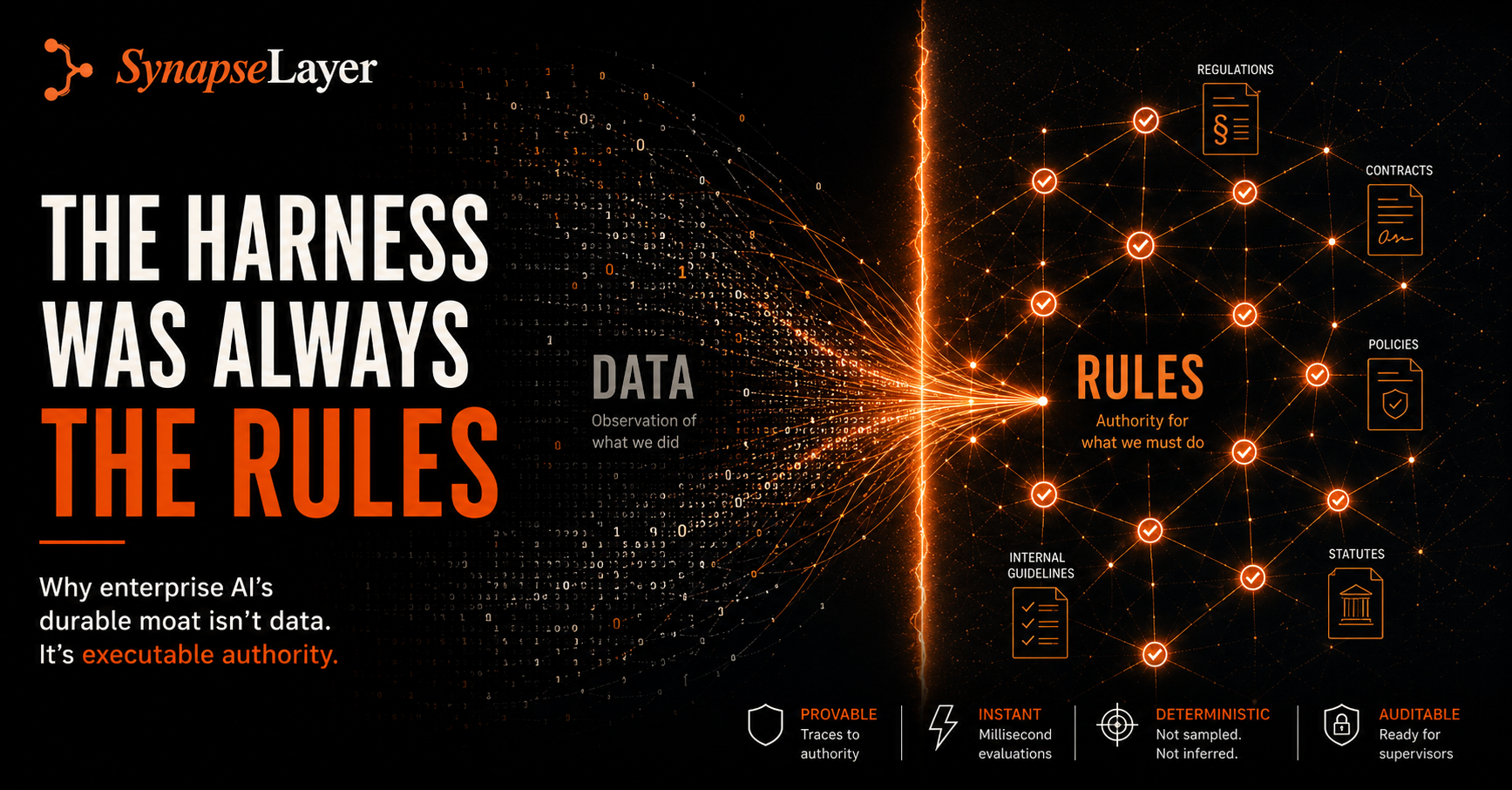
Why enterprise AI’s durable moat isn’t data. It’s executable authority.
A consensus is forming in enterprise AI, and it is one step short of correct. I expect it to take that step by the end of this year. This piece is a dated forecast, written so that it can be checked against what happens, and I would ask you to hold me to it.
The current consensus goes like this. The frontier model is commoditising. The durable value sits in the harness around the model. And the content of that harness is data: the proprietary corrections, edge cases and reasoning traces an enterprise compounds on top of whichever model it rents this quarter. Madrona's investors call it owning the data loop.1 theCUBE calls it data capitalism, against the data communism of everyone renting the same intelligence from the same few labs.2 Alex Karp has spent the summer telling CNBC that enterprises are tired of paying for tokens while the labs walk off with their alpha.3 Satya Nadella has been making the same argument since 2024, most recently telling enterprises to build proprietary learning loops on top of rented models.4
Two thirds of this is right. The model is commoditising. The harness is where the value sits. The remaining third, that the harness is made of data, is the part I expect to fall, and the reason is structural rather than rhetorical.
What data cannot contain
Data is a record of what an organisation did. Rules are what it is bound to do. In an unregulated business the two stay close enough that the distinction costs nothing. In a rule-governed enterprise, a bank, an insurer, a hospital group, a defence contractor, a law firm, they diverge as a matter of course, and the divergence is where the risk lives.
The obligation an enterprise operates under never appears in its action stream. The contract, the statute, the outside counsel guidelines, the internal credit policy: these are the instruments that make conduct binding, and no volume of interaction traces contains them. A loop trained on what the firm did converges on what the firm did, including every workaround, every shortcut, every quiet deviation that has not yet produced a loss event. The loop cannot see that these are deviations, because the standard against which they deviate was never in the training set. It learns the drift and calls it the process.
There is a second defect, and it is the one that decides the question. The flywheel is always behind its own authority. Amend a regulation on Monday and every trace collected before Monday is now evidence of superseded behaviour. The loop cannot learn the new rule until the organisation has acted under it often enough to generate examples, which means the model enforces yesterday's law for as long as it takes the enterprise to accumulate tomorrow's mistakes. A compiled rule set changes the moment the instrument changes. In a regulated market, a moat that lags its own governing authority by a quarter is a liability with good marketing.
None of this makes the data loop worthless. For ranking, personalisation, routing and prediction, compounding on interaction data is the correct architecture, and the flywheel argument holds. My claim is narrower and harder: wherever conduct is governed by binding instruments, the harness cannot be built from observations of conduct. It has to be compiled from the instruments themselves.
Three forces, one direction
Forecasts need a mechanism, so here are the three forces I expect to do the converging.
The first is audit. The moment a supervisor, an auditor or a court asks on what authority an agent acted, “the model learned it from our data” is an admission, and every enterprise that built its harness as a data loop will discover it has no answer of the required kind. Authorisation is a property of rules. It traces to a clause or it does not exist. The demand for that trace arrives with the first serious agent liability disputes, and those are coming this year, because agents are now transacting.
The second is the labs themselves. Grounding agent behaviour in an external rule set, rather than in weights, is the open problem behind every serious piece of work on agent reliability. The lab that publishes on evaluating agent action against compiled external policy will not be endorsing the data loop. It will be describing its limit.
The third force is the data-loop advocates' own economics, followed one step further than they follow it. Their argument runs: a small model fine-tuned on your task beats a frontier model on latency and cost, so bring the loop in-house.5 That reasoning holds, and it does not stop where they stop it. A compiled rule set evaluates in milliseconds with no model call at all, at a cost per evaluation that rounds to zero, and returns a result that can be proved rather than sampled. On the two axes the flywheel crowd chose for themselves, latency and cost, deterministic evaluation of compiled rules is the terminal point of their own reasoning. They stopped at the fine-tuned model because that is the asset class they know how to build. The argument does not stop there.
The forecast
By the end of 2026 you will see the vocabulary shift. Analysts and infrastructure investors who today write about data loops will write about policy, rules and compiled authority as the durable enterprise layer. At least one major vendor will ship or announce compilation from governing documents to executable policy, rather than another observation layer. At least one frontier lab will publish on grounding agent action in rule sets that live outside the weights. Any two of those three and this piece has resolved correct. If the year closes and the consensus still says the harness is data, I have called it wrong, and this page will still be here.
I am not a neutral observer, and you should discount for that. I have spent four years compiling rule sets from governing instruments into deterministic, executable form and running them in regulated capital markets production, and my company sells the position this piece argues for. Discount, and then check the argument, because the argument does not depend on me. There is a compiled operome of the German Criminal Code running in public at operome.dev, every rule traceable to its section, evaluable in milliseconds without a model call.6 That is what a harness looks like when it is built from the instruments instead of the traces.
The industry spent two years saying the value is in the model, then a year saying it is in the harness. Both corrections were right. One more remains. Data tells you what an organisation did. The harness has to hold what it is bound to do, and only the rules contain that. The market is reaching for the word data because it has been the word for value for fifteen years. By December it will have found the right one.
Footnotes
- ↩ Vivek Ramaswami and Sabrina Wu, Own the Data Loop, Aspiring for Intelligence, published via X, July 2026, x.com/vivekramaswami. The authors' earlier piece argued that value in AI is migrating from the frontier model to the harness around it.
- ↩ theCUBE Research, contrasting “data communism” with “data capitalism”, as characterised and quoted in Ramaswami and Wu (n 1).
- ↩ Alex Karp, CNBC Squawk Box appearances, summer 2026, as quoted in Ramaswami and Wu (n 1).
- ↩ Satya Nadella, X, 17 September 2024 (“models themselves become more of a commodity”, with value accruing to grounding and fine-tuning on business data and workflow), x.com/satyanadella/status/1835699037569441844; and his mid-2026 essay urging enterprises to build proprietary learning systems in which human capital and “token capital” compound, reported at the-decoder.com, June 2026.
- ↩ The latency and cost figures for fine-tuned small models against frontier models (Cursor's in-house Tab model, Decagon's sub-400ms support agents, Distil Labs' cost-per-million-requests comparison) are set out in Ramaswami and Wu (n 1).
- ↩ operome.dev. The compiled operome of the German Criminal Code (Strafgesetzbuch) is published under the Apache-2.0 licence; each rule carries provenance to its statutory section and is evaluable through the public interface without any model call.