Deploying Agents Was Step One. Making Them Trustworthy Is Step Two.
February 14, 2026
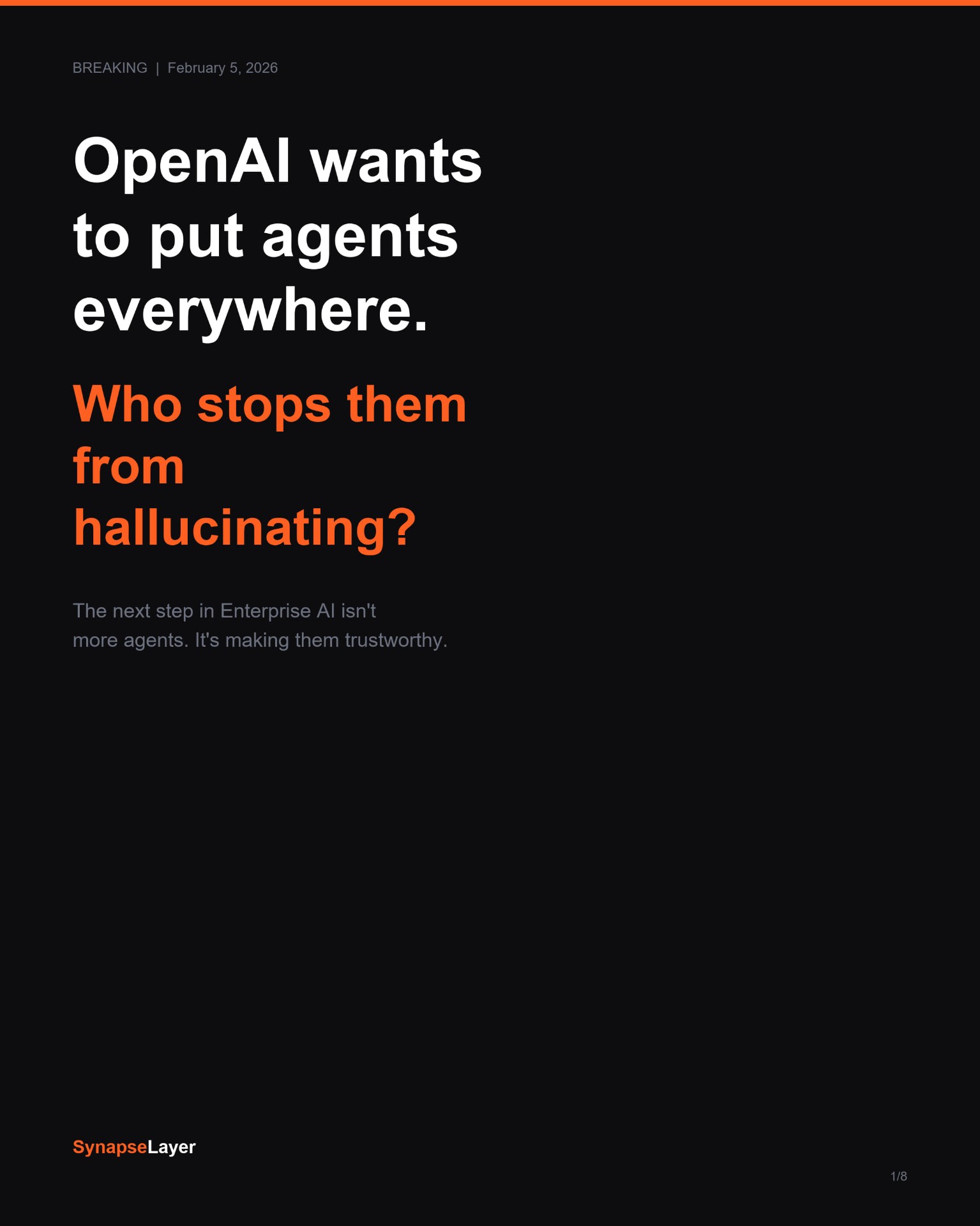
As enterprises deploy AI agents at scale, reliability becomes the limiting factor. Deterministic decision governance is required for enterprise trust.
The deployment phase is over.
OpenAI's launch of Frontier marked a turning point. Enterprises can now deploy AI agents at scale, connect them to business systems, and manage their identity and permissions.
Agent deployment infrastructure is improving rapidly.
But deployment is not reliability.
Connecting agents to data does not tell them what they are allowed to do with that data.
The core problem
LLMs are probabilistic systems.
They generate the most likely output given context. They do not guarantee correctness.
In low-risk consumer applications, that is acceptable.
In enterprise environments — healthcare, capital markets, logistics, insurance — it is not.
A system that is "usually correct" is still unreliable.
The missing layer
Agent platforms solve identity, permissions, data access, and monitoring.
They do not solve deterministic rule enforcement, constraint validation, or execution gating.
Enterprises need more than deployment infrastructure. They need decision governance infrastructure.
That means valid actions are defined before execution, invalid actions are structurally impossible, and every decision path is auditable.
Deployment was step one.
Trustworthy execution is step two.