Everything But The Substrate Is Commoditizing
May 21, 2026
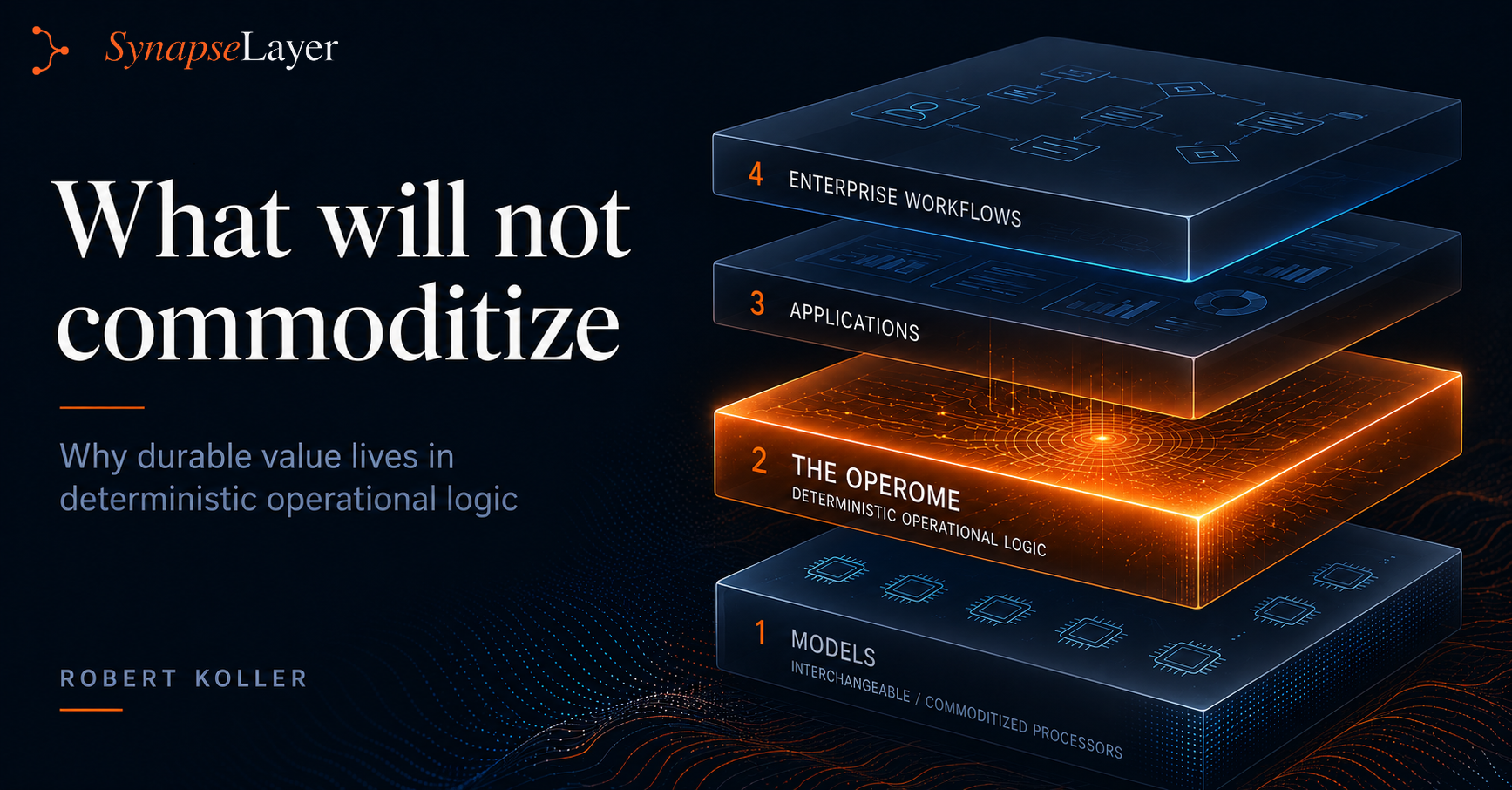
Why the foundation model layer is commoditizing, why the application layer commoditizes once the substrate exists, and why the substrate, the operome, is where enterprise AI value will settle.
I have spent five years building deterministic infrastructure for European debt capital markets, starting with the London Borough of Sutton bond issuance and rebuilt over the last few months to run almost entirely on AI. The deterministic rule layer underneath acts as the verification substrate for AI-driven extraction and operation. Around €700 million issued, 99.98 percent accuracy across more than 100,000 validations, zero compliance violations, supervised by the Luxembourg CSSF.[1]
Every day my team watches the same pattern. The model layer underneath us gets cheaper and more capable on a quarterly cadence, and none of it changes the actual problem we are solving. The rules that govern a bond issuance live in contracts, regulations, and prospectus documentation. Whether we feed those rules into GPT-5.5 or Claude Opus 4.7 or Llama 4 or DeepSeek v3 makes no operational difference. The model is the processor. The operational logic is the software.
Six months ago that observation would have sounded contrarian. Today it is becoming visible to anyone who looks at the evidence honestly.
1. The model is commoditizing in plain sight
Eight foundation models now sit at or near the frontier on every benchmark that matters: GPT-5, Claude 4.7, Gemini 2.5, Llama 4, Grok 4, DeepSeek v3, Qwen 3, Mistral Large 3. Three years ago the gap between first place and eighth on MMLU and GPQA was roughly thirty percentage points. Today it is under eight points and shrinking with every release. Inference prices have collapsed by a factor of sixty in the same window. [2]
Open-weight models are catching closed-weight models within months rather than years. Llama 3 reached GPT-4 quality six months after GPT-4 became the reference. DeepSeek v3 reached Claude's reasoning level within weeks at roughly one percent of the training cost.[3] The Hangzhou and Beijing labs publish weights anyone can download. The pattern is unambiguous: the model layer is becoming a commodity input that any sufficiently funded team can either build, license, or replace.
The clearest acknowledgment came from Mark Zuckerberg on Cleo Abram's channel a few weeks ago. [4] He said every business will end up with its own AI, built on shared models, shaped by the company's products, policies, customer history, and way of working. He did not use the word commoditizing. He did not have to. When the most visible foundation model founder on earth says shared models are exactly that, shared, and the differentiation lives in the layer above the model, he is describing exactly that.
The Claude Code leak from March 31 made the same point from a different angle. When Anthropic accidentally shipped 512,000 lines of TypeScript inside an npm source map file,[5] the codebase that surfaced was not a thin wrapper around a powerful model. It was a complex harness with memory consolidation daemons, three-layer indexed storage, self-healing query loops, opinionated tool batching, and a background process called KAIROS that runs during inactivity to consolidate the agent's memory the way sleep consolidates memory in the human brain. None of that work is the model. All of it is the engineering that turns the model into something useful. Claude Code is reported at $2.5 billion ARR with 80 percent enterprise adoption.[6] That revenue accrues to the harness, not the model.
Poetiq made the case more directly. They took Gemini 3 Pro, which scores 31 percent on ARC-AGI-2 on its own, and wrapped it in an orchestration layer that decomposes problems, generates Python, executes it, audits the failures, and decides when to stop. The combined system scored 54 percent on the ARC-AGI-2 Semi-Private Test Set, beating Google's own Gemini 3 Deep Think which scored 45 percent at more than twice the per-task cost.[7] The result was officially verified by the ARC Prize team and announced on December 5, 2025. Poetiq did not train a new model. They built the harness around an existing one with six former DeepMind researchers. The orchestration layer produced the state-of-the-art result.
Two more pieces of evidence landed in the last sixty days, both more visible than the technical signals above. The first is Harvey, which raised $200 million at an $11 billion valuation in March, co-led by Sequoia and GIC.[8] Harvey does not own a foundation model. It runs on top of OpenAI, Anthropic, and Google. The $11 billion valuation reflects 25,000 custom agents in production across the Am Law 100, embedded legal engineering teams inside Allen & Overy, HSBC, NBCUniversal, and DLA Piper, and $190 million ARR built entirely on the layer above the model. Sequoia partner Pat Grady called Harvey "the playbook for what it means to be an AI-native application company." That playbook does not include training models.
The second piece of evidence is Mistral. On April 28, the same day Manifest OS announced the largest Series A in legal-tech history,[9] Mistral launched Workflows, a Temporal-based orchestration platform pitched directly at enterprise automation.[10] Their VP of go-to-market told VentureBeat the bottleneck is operational, not model. "Organizations are struggling to go beyond isolated proofs of concept. The gap is operational." This is the foundation model company itself declaring that the durable value lives above the model. Three months earlier, in February, Mistral signed a multi-year partnership with Accenture as the implementation partner for European industrial customers.[11] The strategic pivot is not subtle. The company that was supposed to be Europe's foundation model champion is becoming a hybrid that sells orchestration and bespoke integration alongside the model.
The most explicit acknowledgment landed twice in two days from a16z. On May 13, Seema Amble published "Is Software Losing Its Head?" arguing that systems of record are going headless and that the new defensible layer is above the database, in policies, audit trails, and agent-callable permissioning. [12] The next morning, Gio Ahern, Steph Zhang, and Alex Immerman published "From System of Record to System of Intelligence," framed by a16z's editor as a continuation of the same thesis, arguing that the reasoning layer above the database is where the next generation of enterprise companies is being built, and that "encoding the actual logic of how sales and marketing teams operate" is the new application layer. [13] Two pieces from four a16z partners across forty-eight hours. The most distribution-rich infrastructure-investing firm on earth is publicly committing to the thesis that the application layer above the SoR captures the durable value. That is the cleanest possible statement of where the consensus sits today. It is also the assumption this paper unsettles.
These are six independent proofs of the same observation. Zuckerberg explicitly. Claude Code accidentally. Poetiq through a benchmark result. Harvey through an $11 billion valuation. Mistral through its own product strategy. a16z by publishing a multi-day thesis arc that names the layer above the model as the durable one. The differentiation is not in the model. The differentiation is in the layer that sits between the model and the work the model is being asked to do. The next question is whether that layer is the application layer everyone is naming, or the substrate beneath it that almost no one is naming.
2. The trillion-dollar capex wave is defensive, not offensive
There is an obvious objection to the commoditization thesis. Meta is spending hundreds of millions of dollars on individual AI researchers. Meta paid $14.3 billion to acquire 49 percent of Scale AI and install Alexandr Wang as Chief AI Officer. Meta offered pay packages worth up to $300 million over four years to staff Meta Superintelligence Labs.[14] OpenAI has committed $500 billion with SoftBank and Oracle to build the Stargate data center network. The five largest US hyperscalers have collectively committed between $660 billion and $690 billion in 2026 capex alone, nearly doubling 2025 levels.[15] If frontier models are commoditizing, why is anyone spending these numbers?
The honest answer is that they are not buying assets at those prices. They are buying insurance.
Meta's entire business is advertising. Ninety-seven percent of revenue. The advertising flywheel depends on Meta sitting between users and the content they want to consume. If the application layer that people use to interact with the internet routes through a model Meta does not control, the flywheel breaks. Zuckerberg is not paying $300 million packages because he believes in winner-take-all foundation models. He is paying them because Meta cannot afford to be second in a market the existing ad business depends on. Meta's own 2026 capex guidance runs $115 to $135 billion,[16] and that is not the spending pattern of a company placing an asset bet. It is the spending pattern of a company defending an existing revenue stream against displacement.
The same logic applies to every large incumbent in the current spending cycle. Microsoft's Copilot strategy exists because if Office 365 becomes a commodity productivity suite while a competing AI assistant owns the enterprise application layer above it, the franchise erodes. Google needs Gemini to own search-replacement behavior because if it does not, the search business that funds everything else compresses. Amazon needs Anthropic and Bedrock to own enterprise AI workloads because if it does not, AWS margins compress. Every one of these bets is a defensive move against the layer above the model rather than an offensive bet on owning the model itself.
If you take the defensive interpretation seriously, the spending wave proves the commoditization thesis instead of refuting it. The incumbents have already implicitly conceded that the model layer is not where the durable value accrues. They are spending what they are spending to protect existing revenue streams from being displaced by whatever sits between the substrate and the customer. The rational question is no longer who wins the frontier model race. The rational question is what the layer above the substrate looks like, who builds it, and how it gets priced. The clearest single confirmation came on May 4, when OpenAI and Anthropic announced, within minutes of each other, separate enterprise joint ventures with the largest private-equity firms in the world: OpenAI with TPG, Brookfield, Advent and Bain at a $10 billion structure, and Anthropic with Blackstone, Hellman & Friedman and Goldman Sachs at a $1.5 billion structure, both backed by additional asset managers and PE houses including Apollo, General Atlantic, Sequoia and GIC.[17] The frontier model companies have just publicly conceded that their models alone are not enough; they need PE-orchestrated deployment muscle to move enterprise value, because the substrate beneath them is the gap.
3. Where the differentiation actually migrates
Classical economics gives you three places the differentiation can go when a substrate commoditizes. It can migrate downward into the inputs that feed the substrate, which is the NVIDIA bet on compute and the energy-infrastructure bet on power. It can migrate sideways into proprietary data, which is the vertical SaaS bet. Or it can migrate upward into the layer that knows what specific work the substrate is being used for.
The upward migration is the one that matters for enterprise value, and there is a structural argument about which layer captures it that most analysts miss.
There are three layers in the enterprise AI stack. The model. The substrate. The application.
The model is the processor: GPT-5, Claude 4.7, Gemini 2.5, Llama 4. Commoditizing on a quarterly cadence, as the first section of this paper documented.
The application is what the user sees and what the agent invokes: Harvey for legal, Manifest for legal services, Legora for legal practice management, Lio for procurement, FurtherAI for insurance, AUI for customer service, Eragon as a generic interface to legacy enterprise software. Sequoia partner Julien Bek's March 5 essay "Services: The New Software"[18] priced this entire category at trillion-dollar scale and named it the autopilot model: don't sell tools, sell the finished work. Manifest OS just got a $750 million Series A on that exact thesis.[19] Harvey at $11 billion is the same play in a different vertical. Paul Graham visited Legora last week and predicted it would surpass Harvey by 2027.
a16z's two-day arc this week makes the application-layer argument more explicitly than anyone has before. Amble names the system of intelligence above the SoR as the new moat. Ahern, Zhang and Immerman extend the argument with the orchestration thesis: agents pulling structured data from many systems simultaneously, synthesizing across them, and treating the underlying database as infrastructure. Their conclusion: "between the model and the customer sits an enormous amount of unglamorous and domain-specific work: orchestrating context across dozens of connected systems, encoding the actual logic of how sales and marketing teams operate, handling permissions and compliance, integrating with the chaotic reality of a Fortune 500 IT environment. That work is the new GTM application layer." They are pointing at a real layer. They are also, almost in passing, pointing at the substrate beneath it. "Encoding the actual logic of how sales and marketing teams operate" is the operome described from above. The application layer they describe needs that encoded logic to function. Once the logic is compiled and exposed as substrate, the orchestration layer becomes one of many possible consumers of it.
The substrate is what every one of those application companies needs in order to function and is currently building manually inside their own walls. It is the compiled rule layer: contracts, policies, regulations, and procedures translated into a form a machine can execute against. We named the artifact the operome in our previous paper.[20] Six weeks later, Google's AI Overview indexed the term as the canonical category-defining vocabulary for regulated AI. The vocabulary is consolidating in real time.
The application layer captures attention and capital in the brief window before the substrate exists openly. Once the substrate exists, the application layer commoditizes the way the model layer is already commoditizing. This is the pattern Snowflake established against the BI tools above it. Once Snowflake and BigQuery existed as the data substrate, dozens of application-layer companies competed on top: Looker, Tableau, Power BI, Mode, ThoughtSpot, Sigma. None of them displaced the substrate. The substrate captured the durable value. The application layer fragmented and competed on UX, pricing, and integration depth.
The same dynamic is now arriving in the enterprise rules layer. Today Harvey, Manifest, and Legora each look like defensible vertical companies because each is privately compiling the legal substrate inside its own product. Tomorrow, when the legal operome exists openly as infrastructure, customers can plug their own UX, their preferred LLM, their existing case-management tools, or their internal teams directly into the substrate. The application-layer moat erodes. The substrate moat does not. This is the structural argument PG misses when he says law is the territory you can defend against the model companies. The territory you can defend is one floor lower than he is looking. Legal firms will not need Legora once they have the legal operome. They will need their own UX on top of the legal operome, and the operome is the layer that is hard to build, costs years to compile, and only gets harder as regulation evolves.
How thin those walls already are became public in early May, when Will Chen, a former Latham & Watkins associate, rebuilt, in two weeks of evenings, an open-source clone of Harvey's core web application, called Mike. Released under AGPL, bring-your-own-Claude or Gemini key, the project hit 2,200 GitHub stars and 600 forks within days. The point is not that Mike is a replacement for Harvey. It is not. The point is that the substantive distance between an $11 billion application-layer company and a single competent developer with a fortnight is two weeks of after-hours work, because the substrate is the same: a frontier model underneath, an interface on top, and no proprietary compiled rule layer in between.[21]
This applies to every regulated vertical. Harvey for legal. Manifest for legal services. Legora for practice management. The same pattern in insurance, healthcare, hospitality, capital markets, and supply chain. Each vertical has application-layer winners forming right now. Each will commoditize the moment the substrate exists for that vertical. The durable layer is the substrate.
The auditor reinforces this argument. In regulated industries, the auditor enforces the documents, not the observed behavior. A context graph[22] that learns what your company has actually been doing tells you nothing about whether the regulator will accept it. A prescriptive rule extracted from the source contract tells you exactly what the regulator will accept and what it will not. Gartner's February 2026 research named context graphs as essential agentic infrastructure.[23] That research got the diagnosis right. It did not go the next step and distinguish between the empirical context graph and the normative substrate underneath it. The distinction matters because the auditor only enforces the second one, and the application layer cannot run without it.
The economics are not subtle. Global enterprise consulting and compliance spend in the Fortune 2000 sits somewhere between $500 billion and $1 trillion annually.[24] A meaningful fraction of that spend is the human work of extracting rules from contracts and regulations, verifying operations against those rules, and updating the rules when regulations change. The substrate automates that work and captures it as software revenue rather than billable hours.
The right valuation comparable for a company that owns the substrate in five to seven regulated industries is not Celonis at $13 billion. The right comparables are Palantir at approximately $350 billion, ServiceNow at approximately $108 billion, SAP at approximately $300 billion, Oracle at approximately $460 billion. [25] Those are companies that took work previously done by consultants, turned it into infrastructure, and captured the consulting spend as recurring software revenue. The pattern is well understood and it has produced multiple hundred-billion-dollar companies in successive technology waves. It is producing another one now, and the substrate above the commoditizing model is where it is forming. SAP and Celonis just announced where they think the substrate lives, and both got it wrong in the same week. SAP launched the Autonomous Suite at Sapphire, positioning its compiled runtime rules as the context layer that agents should consult. Celonis announced the Context Model and the planned acquisition of Ikigai, positioning its event logs and the predictive layer on top as the context layer. Both say the same thing in different vocabularies: enterprise AI is useless without context, and we are the source of it. Both are wrong about where the context lives. SAP's compiled rules reflect an implementation team's reading of the source rule at the moment they configured it, frozen in place since then. Celonis's event logs reconstruct what people and systems actually did, including the workarounds and shortcuts that drifted from the rule the configuration was supposed to enforce. Predicting the future on top of that reconstruction gives confident predictions of stale reality. The actually-current context lives upstream of both layers, in the contracts, policies, regulations, pricing schedules, and procedures that govern the work today. Compile from source. Skip the runtime drift. Skip the implementation drift. That is the substrate.[26]
Palantir is the most instructive single case. The market cap reflects what manual ontology extraction is worth even when every deployment requires Forward Deployed Engineers and the unit economics scale linearly with headcount. Alex Karp has said for a decade that the model is not the product, the deployment is. The leaked Claude Code harness, the Poetiq orchestration layer, the Palantir FDE business, Harvey's embedded legal engineering teams, and Mistral's services pivot are five independent pieces of evidence pointing at the same conclusion. The intelligence sits between the model and the actual work. Palantir built that intelligence one client at a time. SynapseLayer publishes it as substrate.
4. What this means for the next 24 months
The commoditization thesis is not a prediction. It is a description of what has already happened and what current capital flows imply about where the industry is going. The question is not whether frontier models will commoditize. They already have, and the trillion-dollar defensive spending wave from incumbents is the proof. The question is how quickly the market reprices the substrate that sits between the model and the application, and which companies in that substrate end up as the durable winners.
Four things will happen between now and the second quarter of 2028. The foundation model capex wave will continue through 2026 and peak in early 2027 before flattening. The application layer will fragment across verticals, with several billion-dollar valuations and an equal number of quiet collapses. The substrate layer will become a named category in venture portfolios, investor reports, and corporate AI strategy decks, with two or three companies recognized as the substrate category leaders. And the substrate companies will compound across vertical after vertical, because the extraction primitives are vertical-agnostic. Capital markets, defence, hospitality, healthcare, insurance, logistics: every rule-dense, high-stakes enterprise needs the same machinery underneath. The 24-month window is when the category is recognized before the premium that recognition brings.
The category naming is no longer hypothetical. a16z's two-piece arc this week is the most public attempt to date to define the durable layer above the SoR. Foundation Capital named context graphs in December 2025. Sequoia named the autopilot thesis in March. Menlo and Kleiner priced the legal application layer at $750 million in April. a16z has now named the system of intelligence in May. Each of these firms is staking a position on the layer above the model. None of them has yet named the substrate beneath the application layer. The window for being the first to name it publicly, with production proof in regulated industries, is the window this paper is written into.
That category timing is also a YC timing question. The Summer 2026 Request for Startups names this category in four of its fifteen items: Item 2 (AI-Native Service Companies, the autopilot thesis), Item 4 (Company Brain), Item 12 (Software for Agents), and Item 15 (The AI Operating System for Companies). When the most distribution-rich startup brand in the world names a category four times in one RFS, the cohort of new applicants forms against that vocabulary in the following six months. The window for being the first-named substrate provider in the category is open and narrowing.
What I am building sits exactly in this category. SynapseLayer extracts the rules from contracts, regulations, and policies, compiles them into the operome, and publishes the substrate that enterprises and AI agents can run their operations against. We are deploying the same substrate we run in capital markets into defence, legal, insurance, hospitality, urban planning and rail, with named lighthouse engagements in each vertical.
The Claude Code leak showed that the LLM is the processor. The Poetiq result showed that the orchestration layer is what unlocks performance. The Palantir market cap showed that the manual version of substrate construction is already worth hundreds of billions of dollars. Harvey's $11 billion valuation, Manifest's $750 million Series A, and Paul Graham's Legora endorsement showed that the application layer above the substrate is repricing fast. Mistral's pivot showed that even foundation model companies have conceded the model is not where the value is. a16z's two-day arc this week named the layer above the SoR as the new moat and stopped one architectural floor short of the substrate. Zuckerberg told Cleo Abram that every business will have its own AI shaped by its policies and way of working. None of these signals say the future of enterprise AI lives inside the model. None say it lives in the application layer either, because the application layer commoditizes once the substrate exists openly. All of them point to the substrate underneath as the durable layer.
LLMs will change many times in the next ten years. The business rules they need to follow will not. We encode the part that stays.
Sources and notes
1. fDesk / NowCM Luxembourg S.A. production data, Luxembourg CSSF supervised. ~€700M in debt capital markets processing, 99.98% accuracy across 100,000+ validations, zero compliance violations, approximately 7,000 variables, 35,000 business rules, 50 micro-classes across 10 functional domains. Five years of production operation starting with the London Borough of Sutton bond issuance, rebuilt to run almost entirely on AI over the last few months with the deterministic rule layer as verification substrate. Source →
2. Appenzeller, G., "Welcome to LLMflation : LLM inference cost is going down fast," November 2024, updated 2025. Token prices for equivalent-capability models fell by orders of magnitude between GPT-4's release and Q1 2026; cited figures from Epoch AI on PhD-benchmark inference cost decline (approximately 40x per year) and broader market analyses showing 300-600x compression in token prices over the same window. The 60x figure used here is conservative within that range. Source →
3. Fortune, July 2025. Meta's Llama 4 release in April 2025 was widely criticized for rushed execution and performance metric allegations. DeepSeek v3 launched December 2024 and reached Claude-level reasoning at approximately 1% of comparable training cost; Llama 3 reached GPT-4 quality approximately six months after GPT-4's release. Source →
4. Mark Zuckerberg, interview with Cleo Abram, YouTube, April 2026. "OpenAI, Google, they're building an AI. But I think we're gonna have a lot of different AI systems, just like we have a lot of different apps. I think in the future, every business, just like I have a website and a phone number and an email address, a social media account, is also going to have an AI that can interact with their customers to help them sell things, help them give support." Source →
5. Shou, C. (@Fried_rice), X post, March 31, 2026. Anthropic's Claude Code CLI v2.1.88 shipped a 59.8 MB source map to npm exposing approximately 512,000 lines of TypeScript across 1,900 files. Reported by InfoQ, April 2026; The Register, "Anthropic accidentally exposes Claude Code source code," March 31, 2026; VentureBeat, April 2026; Zscaler ThreatLabz, April 2026. Anthropic statement to CNBC: "a release packaging issue caused by human error, not a security breach." Source →
6. VentureBeat, April 2026, citing Anthropic's $19 billion annualized revenue run-rate as of March 2026 and Claude Code's $2.5 billion ARR with 80% enterprise adoption. Source →
7. ARC Prize 2025 Technical Report, arXiv 2601.10904, January 2026; Poetiq.ai, "Poetiq Shatters ARC-AGI-2 State of the Art at Half the Cost," December 5, 2025. Officially verified Gemini 3 Pro refinement harness: 54% on ARC-AGI-2 Semi-Private Test Set at $30.57 per task, versus Gemini 3 Deep Think at 45% and $77.16 per task. Poetiq founded June 2025 by Shumeet Baluja and Ian Fischer, both former Google DeepMind. Source →
8. CNBC, March 25, 2026, "Legal AI startup Harvey valued at $11 billion in funding round." $200M raised, co-led by GIC and Sequoia, total funding over $1B. 25,000+ custom agents in production. 1,300 organizations across 60 countries including most of the Am Law 100. ARR reported at $190M as of January 2026, up from $100M in August 2025. Sequoia partner Pat Grady: "They sort of wrote the playbook for what it means to be an AI-native application company." Source →
9. Manifest OS announced $60M Series A at $750M valuation on April 28, 2026, led by Menlo Ventures and Kleiner Perkins. AI-native law firm model: 18 months of operations starting with immigration law in Arizona under the ABS program, 3,000+ client engagements, expanding to tax. Largest legal-tech Series A in history. Source →
10. VentureBeat, April 28, 2026, "Mistral AI launches Workflows, a Temporal-powered orchestration engine already running millions of daily executions." Workflows is a Temporal-based orchestration platform inside Mistral Studio. Quote from Elisa Salamanca, VP of go-to-market for Mistral enterprise: "Organizations are struggling to go beyond isolated proofs of concept. The gap is operational. Workflows is the infrastructure to run AI systems reliably across business-critical processes." Approximately 60% of Mistral revenue from Europe per CEO statements; agentic AI market sized at $10.9B in 2026 projected to $199B by 2034. Source →
11. Accenture press release, February 26, 2026, "Accenture and Mistral AI Accelerate Enterprise Reinvention with Scalable AI." Multi-year strategic collaboration to co-develop and deliver enterprise-grade AI solutions, with Accenture becoming a Mistral AI customer and embedding Mistral's models in client solutions. Asian Morning, March 3, 2026, characterized the strategic shift as a pivot from "pure model developer to high-end technical consultancy for the world's largest corporations." Source →
12. Amble, S. "Is Software Losing Its Head?" a16z, May 13, 2026. Argues that the GTM moat shifts from owning the system of record to owning the system of intelligence above it, with new defensibility properties: policies, audit trails, agent-callable permissioning, action layer ownership, real-world execution, and the technical sophistication of the buyer. Source →
13. Ahern, G., Zhang, S., and Immerman, A. "From System of Record to System of Intelligence." a16z, May 14, 2026. Framed by a16z editorial as a continuation of Amble's thesis. Argues that orchestration becomes the new gravity well, that agents treat the CRM as one input rather than the destination, and that "between the model and the customer sits an enormous amount of unglamorous and domain-specific work... encoding the actual logic of how sales and marketing teams operate." Together these two pieces represent the most explicit current statement of the application-layer-captures-value thesis from a Tier 1 investor. Source →
14. Meta acquired 49% of Scale AI for $14.3 billion in June 2025, installing Alexandr Wang as Meta's first Chief AI Officer (Fortune, June 22, 2025). DeepLearning.ai The Batch, December 2025, citing WSJ: Meta offered pay packages worth up to $300 million over four years to staff Meta Superintelligence Labs. Source →
15. Futurum Group, "AI Capex 2026: The $690B Infrastructure Sprint," February 12, 2026. The five largest US hyperscalers (Microsoft, Alphabet, Amazon, Meta, Oracle) have collectively committed between $660B and $690B in 2026 capex, nearly doubling 2025 levels. OpenAI's Stargate project, announced January 2025 with SoftBank and Oracle, targets $500B in AI infrastructure investment by 2029. Source →
16. Meta Platforms Inc., Form 8-K Q4 2025 Earnings Release, SEC filing, January 28, 2026: 2026 capital expenditures, including principal payments on finance leases, in the range of $115-135 billion. 2025 capex was $72.22 billion. Reported by CNBC, Yahoo Finance, January 28-29, 2026. Source →
17. Bloomberg, TechCrunch, CNBC, Axios, Semafor, and Reuters, May 4, 2026. OpenAI announced a $10 billion enterprise joint venture with TPG (anchor), Brookfield, Advent and Bain, ~$4 billion PE commitment; Anthropic announced a $1.5 billion enterprise joint venture with Blackstone, Hellman & Friedman and Goldman Sachs as founding partners, backed by Apollo, General Atlantic, Sequoia, GIC and Leonard Green. Both ventures designed to deploy frontier-model AI inside PE-owned portfolio companies via forward-deployed engineers. Source →
18. Bek, J. "Services: The New Software," Sequoia Capital, March 5, 2026. The autopilot vs copilot framework. Core argument: for every $1 spent on enterprise software, $6 is spent on services; the next $1T company will sell finished work, not tools, capturing services-dollar TAM at software margins. Target verticals named: insurance brokerage, accounting/audit, IT managed services, tax advisory, healthcare revenue cycle, simple legal services, payroll, certain compliance services. Source →
19. Manifest OS Series A, see footnote 8. Manifest is the legal-vertical instantiation of Bek's autopilot thesis, validated by the largest Series A in legal-tech history. Source →
20. Koller, R. "The Operome: Naming the Missing Layer for Enterprise AI," SynapseLayer, March 2026. LinkedIn and X publication. As of April 2026, Google's AI Overview returns the SynapseLayer LinkedIn essay as the canonical definition of "operome" in the AI context, naming Robert Koller as the originator of the term. Source →
21. Chen, W. "Mike." GitHub, AGPL v3, released early May 2026. Open-source replication of Harvey's core web application, built in two weeks by a former Latham & Watkins associate; bring-your-own-key Claude or Gemini deployment; 2,200+ stars and 600+ forks within days of release. The episode generated public commentary on the thinness of frontier-model-wrapper differentiation in legal AI. Source →
22. Gupta, J. and Garg, A. "Context Graphs: AI's Trillion Dollar Opportunity," Foundation Capital, December 2025. Thesis paper published by Foundation Capital partners naming context graphs as a new infrastructure category for enterprise AI. Animesh Koratana (PlayerZero) subsequently published an agent-trajectory approach to building context graphs via observation. Source →
23. Gartner research on context graphs as essential agentic infrastructure, February 2026, co-authored by VP AI Strategy Radu Miclaus and Tom Coshow. Referenced in public LinkedIn posts by both authors and in Gartner client research notes. Source →
24. Global management consulting market estimated at approximately $400B in 2025 (Statista, IBISWorld, Kennedy Consulting Research). Global compliance and regulatory technology spend adds approximately $100-150B annually (Gartner, MarketsandMarkets). Combined professional services addressable market for rule extraction, compliance verification, and regulatory-update work across the Fortune 2000 falls in the $500B-$1T range depending on scope definition. Range is directional for the argument. Source →
25. Market capitalizations as of April 2026, via public market data (companiesmarketcap.com, stockanalysis.com, Yahoo Finance, MacroTrends): Palantir Technologies approximately $350B, ServiceNow approximately $108B, Oracle approximately $460B. SAP market capitalization in the $300B range. Celonis last private valuation approximately $13B (2022 funding round, still private as of April 2026). Market caps fluctuate; verify on publication day. Source →
26. Koller, R. "Celonis just got cooked. SAP is going after their business." LinkedIn, May 2026. Argument: SAP Sapphire 2026 keynote launched the Autonomous Suite positioning SAP's compiled runtime as the context layer for enterprise AI; Celonis announced the Context Model and the planned acquisition of Ikigai, positioning event-log reconstruction plus predictive overlays as the same. Both miss the upstream layer where the rules are written. See also Celonis press, May 2026; SAP Sapphire 2026. Source →
Robert Koller is the Founder and CEO of SynapseLayer, which builds automated ontology infrastructure that compiles operational rules from enterprise documentation. He is a securities lawyer qualified in three jurisdictions with 25+ years in capital markets, including a landmark European Court of Justice case (C-118/09 Koller).
Robert Koller, Founder and CEO, SynapseLayer
rk@synapselayer.ai · synapselayer.ai